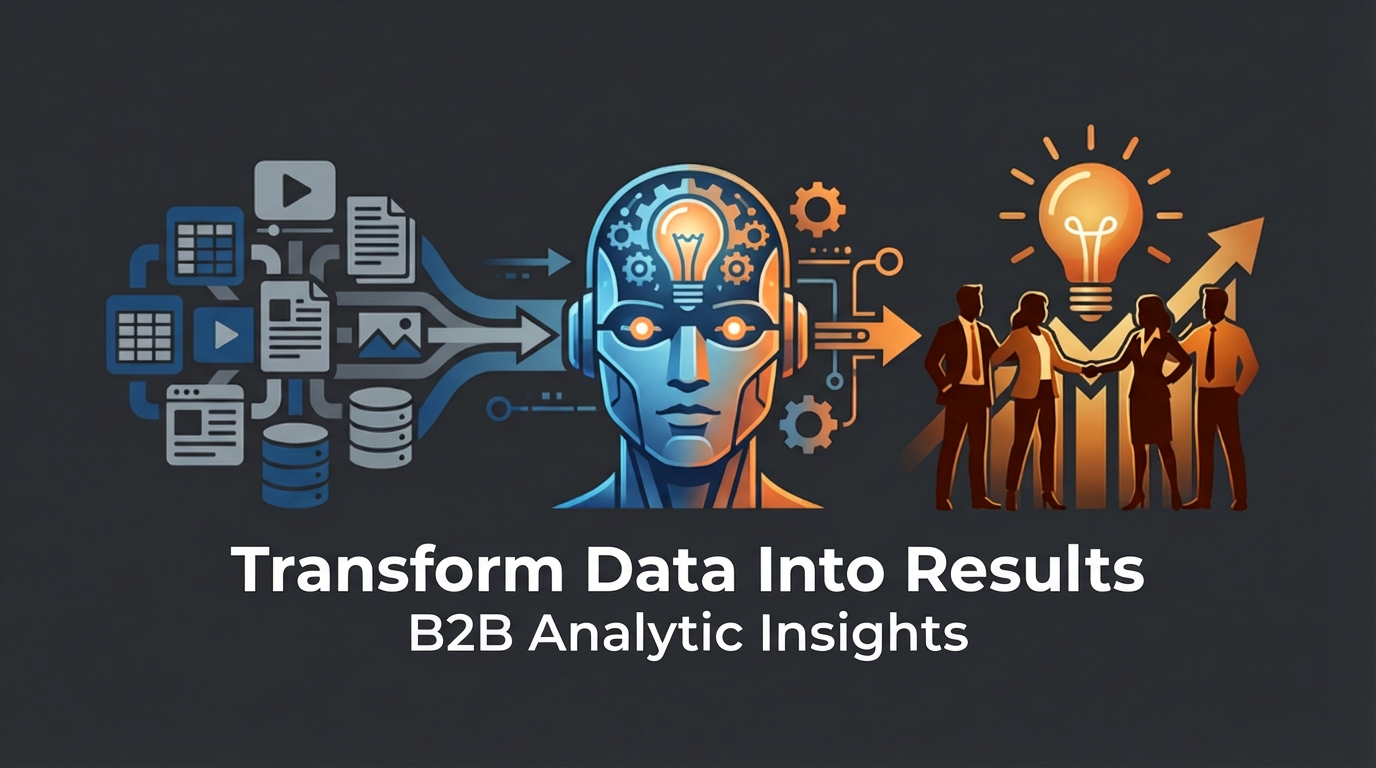

For over two decades, I’ve navigated the complex waters of enterprise data, witnessing its evolution from nascent storage to a strategic asset. We’ve all championed the dashboard. It brought visibility, replacing educated guesses with aggregated metrics. But, let’s be blunt: dashboards, in their traditional form, are rapidly becoming relics. They represent a rearview mirror, a static snapshot of what was. In today’s hyper-competitive B2B landscape—where credit risk can materialize in seconds and operational inefficiencies can bleed millions—we need more than just visibility; we need prescience. We need autonomous insights.
Consider the lifecycle of a typical dashboard. A business requirement arises. Data engineers extract, transform, and load. BI developers build visualizations. Months, sometimes quarters, later, the dashboard is deployed. It’s a monumental effort, only to deliver an answer to a question that might have already shifted. This linear, often reactive, approach simply doesn’t scale with the velocity of modern business decisions.
From Reporting to Reasoning: The Cognitive Gap
Traditional BI tools, while invaluable for historical summarization, struggle with causality. They tell you what happened, but rarely why. As an executive charged with managing risk portfolios or streamlining global supply chains, knowing that delinquency rates increased by 20% in a particular segment is a critical piece of information. But without immediate insight into the drivers – perhaps a new competitor offering aggressive terms, or an unforeseen regional economic downturn – the dashboard merely highlights a problem; it doesn’t initiate a solution. This cognitive gap between data presentation and actionable explanation creates a drag on time-to-insight. Our teams are spending valuable cycles deciphering, correlating, and hypothesizing, rather than acting.
The Problem of Stale Insights and Manual Exploration
Data is a perishable asset. An insight derived from last week’s data, while potentially valid, loses its potency with each passing day. Imagine a financial institution attempting to manage market liquidity. A dashboard updated weekly means decisions are consistently trailing the market. Moreover, discovering deeper patterns within these data sets often requires a highly skilled analyst to endlessly click, filter, and pivot. This manual exploration is time-consuming, expensive, and crucially, limited by human cognitive capacity and biases. We are effectively hunting for insights using a compass in a dynamically shifting landscape, rather than employing GPS that proactively alerts us to critical changes.
In the evolving landscape of data analytics, the article “Beyond Dashboards: How AI Transforms Data into Autonomous Insights” highlights the significant shift towards automated data interpretation. For further exploration of this topic, you may find the article on the importance of understanding data-driven decision-making in the business realm insightful. You can read more about it here: Understanding Data-Driven Decision Making. This resource complements the discussion on how AI is revolutionizing the way organizations derive actionable insights from their data.
AI as the Engine for Autonomous Insights
This is where artificial intelligence steps in, not as a replacement for human intelligence, but as an amplifier. AI shifts data from passive reporting to active, conversational reasoning. It moves us beyond simply seeing metrics to understanding motives, predicting outcomes, and prescribing actions. The true power of AI in analytics lies in its ability to detect patterns and subtle signals that human analysts, even with sophisticated tools, consistently miss.
Dynamic Decision-Making: Beyond Static Thresholds
Machine learning algorithms, particularly those specialized in anomaly detection and pattern recognition, can continuously monitor vast data streams. Consider credit risk assessment: instead of relying on static models and quarterly reviews, AI can identify, in real-time, micro-trends within customer spending behaviors or market sentiment that might indicate an emerging default risk well before it triggers traditional alerts. This transforms our approach from reactive reporting – “a loan went bad” – to proactive reasoning – “these indicators suggest a loan will go bad, and here’s why.” By 2027, Gartner anticipates that 50% of business decisions will be augmented or automated by AI agents. This isn’t a futuristic fantasy; it’s an imminent operational reality that demands our strategic attention.
Conversational BI: The New Paradigm for C-Suite Engagement
Forget the dashboard hunt. The future is conversational. Imagine an executive asking, “Which market segments showed unexpected growth last quarter, and what factors, external or internal, primarily drove that?” The AI, powered by large language models, doesn’t present a pre-filtered dashboard. Instead, it synthesizes information from disparate data sources—market data, sales figures, customer feedback, macroeconomic indicators—and provides a contextual, narrative answer. This direct, question-and-answer interaction dramatically reduces time-to-insight. It changes the operational workflow from “Which dashboard shows X?” to “What’s the story behind Y, and what should we do about it?” This instant, tailored consumption of complex analytical outputs revolutionizes how leaders interact with data, democratizing sophisticated analysis without requiring advanced technical skills from the end-user.
Real-time and Embedded Insights: Decision-Making at the Point of Impact
The ultimate goal of analytics is to inform action. For too long, analytics has operated in a silo, requiring users to leave their operational systems, navigate to a BI platform, extract insight, and then return to their workflow to apply it. This friction introduces latency and dilutes impact.
Operationalizing Intelligence: Insights in the Flow of Work
The strategic imperative is to embed intelligence directly into the operational systems where decisions are actually made. Imagine a procurement professional negotiating with a supplier. As they enter specific terms, an AI agent, embedded within their ERP, provides real-time insights: “Supplier X’s historical on-time delivery rate has decreased by 5% over the last two quarters, and their average dispute resolution time has increased. Consider alternative supplier Y for priority items, or renegotiate terms for a performance-based penalty clause.” This form of “just-in-time” insight eliminates the chasm between analysis and action, empowering frontline employees to make smarter choices without ever leaving their primary applications. It’s akin to moving from consulting a map before a journey to having augmented reality guiding your path in real-time.
Proactive Alerts and Prescriptive Recommendations
Beyond real-time information, AI systems can deliver proactive alerts and even prescriptive recommendations. For instance, in enterprise operations, an AI monitoring IoT sensor data from manufacturing equipment can detect subtle deviations indicating impending machinery failure. Instead of a dashboard showing increasing temperature, the AI sends an alert directly to the maintenance team with a recommendation: “Hydraulic pump #3 on Line C is exhibiting abnormal vibration patterns, suggesting imminent failure within 48 hours. Recommend preventative maintenance now to avoid estimated 12-hour production downtime.” This predictive and prescriptive capability transforms maintenance from a reactive, cost-center activity into a strategically optimized, risk-mitigation function.
The Analytics Transformation: People, Process, and Technology
Implementing autonomous insights isn’t merely a technology upgrade; it’s a comprehensive analytics transformation, impacting people, processes, and tools. This journey requires strategic leadership and a clear understanding that while AI brings unprecedented capabilities, human expertise remains paramount.
Evolving Skill Sets: From Data Janitor to AI Whisperer
The shift demands a re-evaluation of critical skills. The days of solely maintaining dashboards are waning. Instead, organizations need data professionals who excel in data governance, ensuring the quality and integrity of the data that feeds these AI systems. Cybersecurity expertise becomes non-negotiable, given the sensitive nature of autonomously generated insights. Most critically, skills in critical thinking, domain expertise, and the ability to “prompt” and iteratively train AI models become central. We need individuals who can articulate the right questions to the AI, interpret its outputs with nuanced understanding, and apply domain context to generated recommendations. This necessitates a workforce adept at human-AI collaboration, where the AI handles the heavy lifting of pattern detection and synthesis, and humans provide the strategic direction and ethical oversight.
Organizational Change Management: Embracing AI as a Strategic Partner
Adopting autonomous insights requires a deliberate organizational change management strategy. Resistance to change is natural, especially when AI appears to automate tasks previously performed by humans. The message to the workforce must be clear: AI is not designed to replace, but to augment and empower. It frees up human talent from rote data aggregation to focus on higher-value activities: strategic thinking, complex problem-solving, and innovation. This involves establishing clear feedback loops, setting up agile teams for AI model development and deployment, and fostering a culture of continuous learning and adaptation. A key challenge lies in building trust in AI-generated insights, which often requires transparency in model operation and robust validation processes.
In exploring the transformative power of AI in data analysis, a related article titled “The Future of Data Analytics: Embracing AI for Deeper Insights” delves into how artificial intelligence is reshaping the landscape of data interpretation and decision-making. This piece complements the insights found in “Beyond Dashboards: How AI Transforms Data into Autonomous Insights” by providing a broader context on the integration of AI technologies in business intelligence. For more information, you can visit this link.
Strategic Recommendations: Charting the Course Forward
| Metric | Traditional Dashboards | AI-Driven Autonomous Insights | Impact |
|---|---|---|---|
| Data Processing Speed | Minutes to hours | Seconds to minutes | Up to 90% faster decision-making |
| Insight Generation | Manual analysis required | Automated pattern detection and prediction | Reduces human bias and error |
| Scalability | Limited by human capacity | Scales with data volume and complexity | Supports big data environments |
| Real-time Monitoring | Often delayed or static | Continuous, real-time updates and alerts | Enables proactive decision-making |
| User Interaction | Requires technical expertise | Natural language queries and conversational AI | Improves accessibility for non-technical users |
| Predictive Accuracy | Basic trend analysis | Advanced machine learning models | Enhances forecasting reliability |
| Cost Efficiency | High manual labor costs | Automated insights reduce labor needs | Lower operational expenses |
For organizations serious about harnessing the power of autonomous insights, the path forward involves a multi-pronged approach rooted in strategic clarity and pragmatic execution. This is not about chasing the latest shiny object, but about building sustainable analytical capabilities.
Invest in a Robust Data Foundation and Governance Framework
Autonomous insights depend entirely on high-quality, readily accessible data. This means a significant investment in data infrastructure, including cloud-native data platforms, data lakes, and robust data warehousing solutions. Crucially, a comprehensive data governance framework is non-negotiable. Without clear definitions, data lineage, and quality controls, AI models will simply amplify garbage, producing misleading insights. Focus on establishing data stewards, implementing automated data quality checks, and building a single source of truth for critical business metrics. This is the bedrock upon which all advanced analytics rests.
Prioritize Use Cases with Clear Business Value and Measurable ROI
Don’t attempt to apply AI everywhere at once. Identify acute business problems where the impact of faster, more accurate insights can be directly measured in terms of reduced costs, increased revenue, or mitigated risk. For a financial institution, this might be real-time fraud detection or dynamic credit limit adjustments. For an operational enterprise, it could be predictive maintenance or supply chain optimization. Start with pilot projects that demonstrate tangible ROI within B2B contexts. This builds internal champions, secures further investment, and creates a blueprint for future expansion. Quantify the value—e.g., “AI-driven fraud detection reduced false positives by 30% and identified 15% more high-value fraud instances, saving $X million annually.”
Foster a Culture of Continuous Learning and Collaboration
The journey to autonomous insights is iterative and requires a symbiotic relationship between technology and human expertise. Invest in upskilling your analytics teams, not just in AI tools, but in critical thinking, ethical AI practices, and business domain knowledge. Encourage collaboration between data scientists, business analysts, and domain experts. The best AI models are those built with deep business context, and the most effective insights come from a blend of AI-driven discovery and human interpretation. Establish communities of practice, integrate AI experimentation into daily operations, and celebrate successes. The goal is to move from data scarcity to data abundance, and from manual analysis to intelligently augmented decision-making, ensuring that your organization remains competitive and strategically agile in an increasingly complex world.