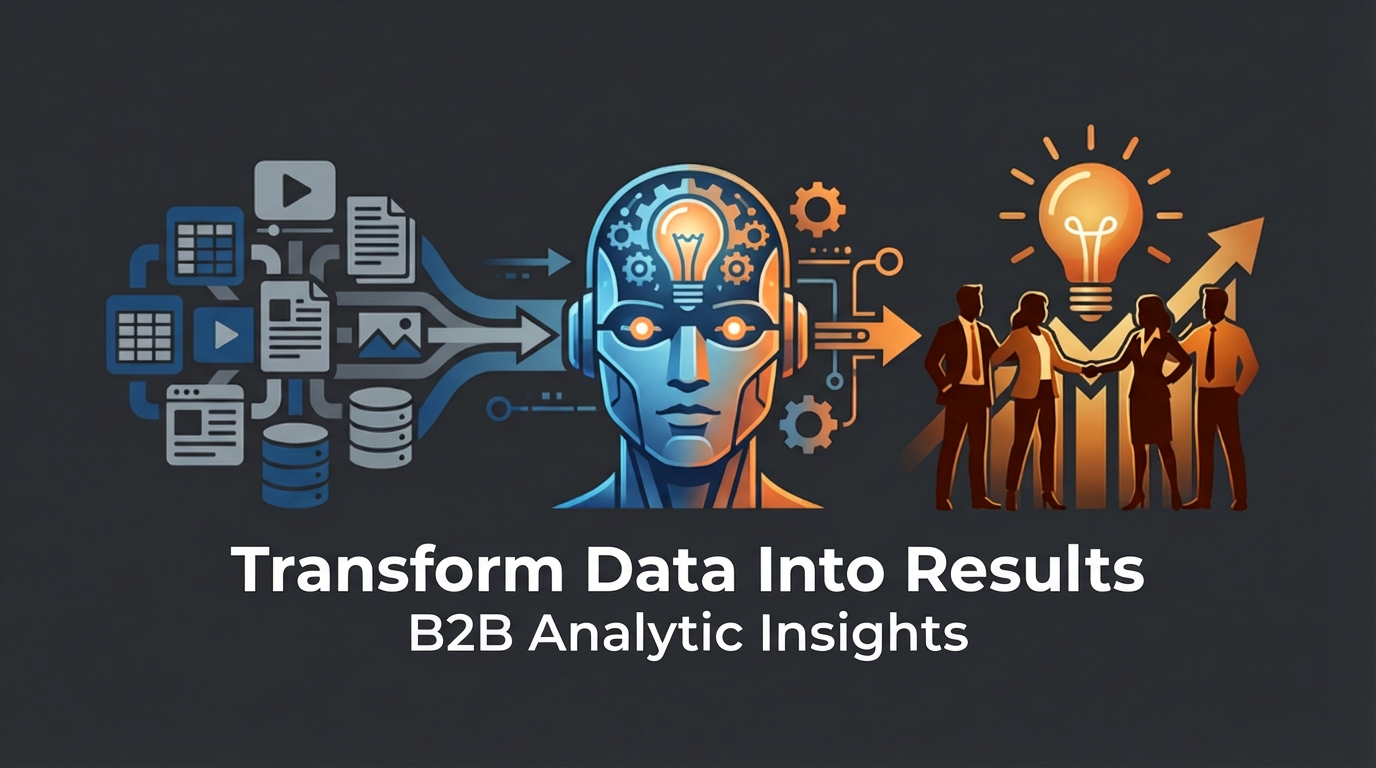

The relentless pursuit of growth in today’s B2B landscape demands more than just sophisticated products or competitive pricing. It requires an intimate understanding of the customer, an understanding that moves beyond historical reporting to proactive insight and predictive action. We’re facing an environment where traditional methods of customer segmentation and engagement are proving increasingly insufficient. Consider the rising cost of customer acquisition, coupled with the imperative to maximize existing customer lifetime value. This isn’t merely about incremental improvements; it’s about a fundamental reimagining of how we leverage customer data to drive quantifiable business outcomes, particularly in areas like credit risk, financial analysis, and enterprise operations. This is where analytics transformation, empowered by AI, steps in, not as a silver bullet, but as a critical strategic lever.
The Evolving Landscape of Customer Value
For decades, customer analytics has been foundational to B2B success. We’ve matured from basic demographic segmentation to complex behavioral modeling. However, the sheer volume, velocity, and variety of data available today – from transaction histories and service interactions to product usage logs and unstructured feedback – have pushed the boundaries of traditional analytical techniques. The challenge isn’t data scarcity; it’s data paralysis and the inability to convert raw information into actionable intelligence at speed and scale.
From Descriptive to Prescriptive Insights
Historically, much of our customer analytics focused on explaining what happened. We built dashboards to visualize past performance, and reports to summarize trends. While essential for accountability, this backward-looking perspective offers limited strategic guidance. The shift to prescriptive analytics, enabled by AI, allows us to answer what will happen and, critically, what should we do about it. This is particularly potent in mitigating credit risk exposures or identifying cross-sell opportunities that might otherwise be overlooked.
The Imperative of Unified Data
A common impediment to advanced customer analytics is data fragmentation. Customer records often reside in disconnected CRM, ERP, and billing systems, creating a fractured view of the customer journey. True analytics transformation hinges on achieving a unified data layer. As TSIA’s “State of Customer Success 2026” highlights, AI Economics™ validates the financial ROI of unifying data, shifting us from vague sentiment to concrete metrics like net revenue retention. Without a consolidated, clean, and accessible data foundation, even the most sophisticated AI models will struggle to deliver consistent, reliable predictions.
In exploring the transformative effects of AI on customer analytics, an insightful article titled “Customer Analytics Reimagined: AI’s $280M Impact on Indirect Revenue” highlights the significant financial benefits that businesses can achieve through advanced data analysis techniques. For further reading on this topic, you may find the article “Harnessing AI for Enhanced Customer Insights” particularly relevant, as it delves into various strategies for leveraging AI to improve customer understanding and drive revenue growth. You can access it here: Harnessing AI for Enhanced Customer Insights.
AI as a Catalyst for Predictable Revenue Generation
The term “indirect revenue” often refers to avenues like improved customer retention, expanded service contracts, reduced churn, and more effective cross-selling or upselling. These are the critical veins of profitability that AI is poised to invigorate. It’s not about selling more to customers, but identifying and nurturing avenues where customers gain more value, leading to sustained, mutually beneficial relationships.
Harnessing AI for Post-Sales Expansion
The post-sales phase is a treasure trove of potential revenue that often remains underexploited. Magnify.io predicts that AI will drive predictable post-sales revenue by 2026, enabling expansion and revenue orchestration. For B2B organizations, this translates to AI assistants guiding customer success managers to proactively identify opportunities for higher-tier service adoption, additional licenses, or complementary product offerings based on real-time usage patterns and stated needs. This isn’t simply guesswork; it’s data-driven probability.
Proactive Churn Prediction and Prevention
Customer churn, particularly for enterprise clients, represents a significant financial drain. Losing a large account isn’t just a loss of current revenue; it’s the forfeiture of future revenue streams, the impact on product development feedback loops, and the potential for negative market perception. AI-powered churn prediction models, drawing on a vast array of behavioral, operational, and financial data, can flag at-risk accounts with remarkable accuracy. This allows customer success and account management teams to intervene decisively with targeted support, tailored solutions, or proactive engagement strategies, dramatically reducing churn rates. DataMites reports that AI-driven analytics can yield up to a 29% reduction in churn, a metric that directly impacts the bottom line.
Transforming Operational Efficiency and Cost-to-Serve
Beyond driving revenue, AI plays a pivotal role in optimizing operational processes related to customer management. This directly impacts the cost-to-serve, which for many B2B organizations, especially those with complex service offerings or extensive support requirements, can be substantial.
Real-time Operational Intelligence
The ability to react in real-time to emerging customer needs or operational anomalies is a profound competitive advantage. CX Today outlines 2026 trends emphasizing real-time operational intelligence. Imagine a scenario where an AI system monitors a client’s product performance data, identifies a potential issue before failure, and automatically triggers a preventative maintenance alert or creates a pre-populated support ticket. This proactive engagement not only prevents service disruptions but also significantly reduces the reactive workload on support teams, leading to higher customer satisfaction and lower operational costs.
Empowering Lean Teams with AI Assistants
The talent crunch is real, and the demand for skilled customer success and account management professionals often outstrips supply. AI assistants can dramatically amplify the capacity of existing teams. By automating routine inquiries, summarizing customer interactions, suggesting optimal responses, and identifying critical action items, AI frees up human experts to focus on high-value, complex problem-solving and strategic relationship building. Magnify.io’s prediction of AI assistants enabling expansion and revenue orchestration in lean teams underscores this efficiency gain. This isn’t about replacing humans; it’s about augmenting human capability and allowing specialists to operate at the top of their license.
Bridging the Technical to the Strategic: Analytics Transformation in Practice
Implementing advanced customer analytics is not solely a technology project; it is an organizational transformation. It requires a clear strategic vision, executive buy-in, and a thoughtful approach to change management.
Establishing a Robust Data Foundation
Before any sophisticated AI model can be deployed, the underlying data infrastructure must be robust. This involves significant investments in data governance, data quality initiatives, and the creation of integrated data lakes or warehouses. Without clean, consistent, and accessible data, AI applications will either fail or produce unreliable results. This initial investment, though often significant, forms the bedrock for all subsequent analytics endeavors.
Iterative Development and Business Alignment
The most successful analytics transformations adopt an iterative, agile approach. Instead of aiming for one massive, all-encompassing system, focus on delivering tangible value through smaller, well-defined projects. Start with a critical business problem – perhaps reducing churn for a specific customer segment or optimizing credit risk assessment for new clients – and build an AI solution around it. Close collaboration between analytics teams, business stakeholders, and operational personnel is paramount to ensure that the developed solutions are both technically sound and practically applicable, driving real business impact and fostering adoption.
In exploring the transformative effects of customer analytics, it’s fascinating to consider how AI is reshaping indirect revenue streams, as highlighted in the article “Customer Analytics Reimagined: AI’s $280M Impact on Indirect Revenue.” This topic aligns closely with another insightful piece that discusses the broader implications of analytics in business, which can be found in the article on the power of analytics. Both articles emphasize the critical role of data-driven decision-making in enhancing operational efficiency and driving growth.
The Human Element: The Irreplaceable Role of Expertise and Trust
While AI promises unprecedented levels of automation and insight, it is crucial to temper expectations and acknowledge the enduring importance of human expertise. AI is a tool, a powerful enhancer, but not a replacement for human judgment, empathy, and strategic thinking.
AI as an Augmenter, Not a Replacer
Data Society notes that while AI reshapes revenue through efficiency and personalization, humans retain the critical role of trust-building. In B2B relationships, trust is often built over years, through consistent performance, transparent communication, and empathetic problem-solving. AI can provide insights to inform these interactions, but it cannot fully replicate the nuances of human connection. A customer success manager, armed with AI-driven insights about a client’s potential pain points or growth opportunities, can have a far more impactful and trust-building conversation than one operating without such intelligence.
Cultivating Analytical Literacy Across the Organization
For analytics transformation to truly take hold, the entire organization needs to elevate its analytical literacy. This isn’t about turning everyone into a data scientist, but about fostering a data-driven culture where decisions are increasingly informed by evidence, not just intuition. Training programs, internal champions, and easy-to-use analytical tools can empower business users to interact with data, understand insights, and ask more sophisticated questions, accelerating time-to-insight across the board.
Strategic Recommendations for the C-Suite
For C-suite executives, the focus must remain on strategic vision, resource allocation, and organizational alignment. The promise of significant revenue impact from reimagined customer analytics is real, but it requires deliberate, structured action.
- Prioritize Data Modernization: View the investment in data infrastructure, governance, and quality as a foundational strategic imperative, not just an IT project. A unified, clean data layer is non-negotiable for AI success.
- Champion Cross-Functional Collaboration: Break down silos between IT, analytics, sales, marketing, and customer success. Establish a common language and shared objectives around customer value and indirect revenue growth.
- Invest in AI-Driven Talent Augmentation: Focus on solutions that empower existing teams, like AI assistants and predictive tools, rather than solely on automation that displaces human roles. Remember that human trust-building remains paramount in B2B.
- Embrace Incremental Value Delivery: Start with high-impact, achievable projects in areas like churn reduction, credit risk optimization, or expansion identification. Demonstrate clear ROI to build momentum and secure further investment.
- Foster an Analytics-Driven Culture: Drive change management from the top. Emphasize continuous learning, data literacy, and the integration of analytical insights into daily decision-making processes across all levels of the organization.
The journey to fully realize the potential of AI in customer analytics is complex, requiring both technological prowess and organizational agility. It’s not about immediate, mythical “$280M impacts,” but about building sustainable, data-driven capabilities that relentlessly optimize customer lifetime value, mitigate risks, and ultimately, drive verifiable, predictable revenue growth in the years to come.