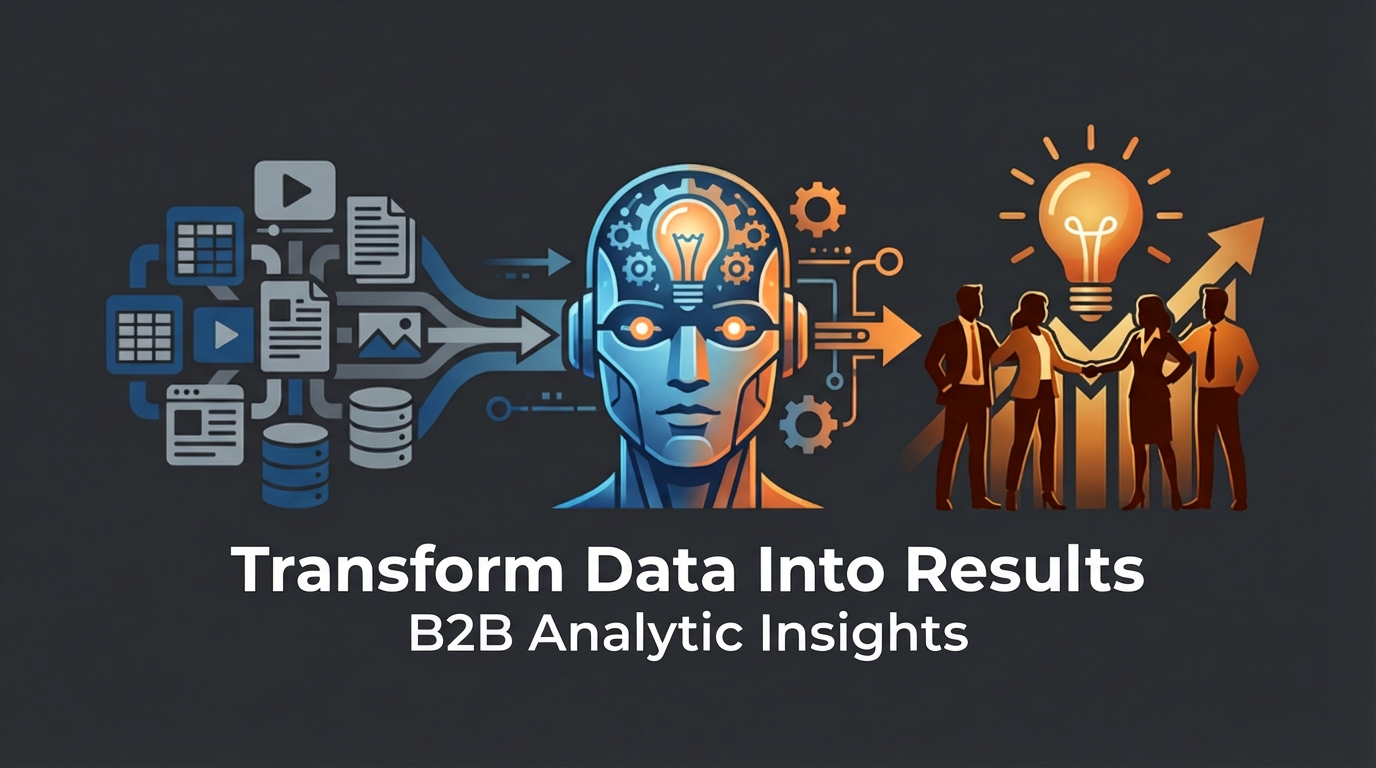

The C-suite inbox is overflowing. Every day, new challenges emerge, demanding swift, informed responses. Is your organization equipped to move with the speed required not just to compete, but to lead? This isn’t about incremental improvements; it’s about a fundamental shift in how strategic choices are made. We’re not just talking about faster data processing; we’re talking about Decision Velocity, the critical advantage in today’s volatile B2B landscape.
For over two decades, I’ve witnessed the evolution of analytics from a supportive function to a strategic imperative. The advent of AI represents a quantum leap, transforming our ability to not only understand complex financial scenarios and credit risks but to actively drive enterprise operations with unprecedented agility. The promise of AI in this domain is compelling: slashing the time between a critical business question and actionable insight from weeks and months down to minutes. This acceleration is not merely a technological marvel; it is a potent enabler of proactive, data-driven decision making.
We are entering an era where the ability to make rapid, accurate decisions can mean the difference between market leadership and obsolescence. The traditional, often protracted, decision-making processes are no longer adequate. Organizations are grappling with a constant influx of data, increasingly complex interdependencies across departments, and the relentless pressure to deliver demonstrable ROI. The question isn’t whether AI can help, it’s how deeply it can integrate to redefine our entire strategic toolkit.
The Unseen Bottleneck: Friction in Strategic Choices
For too long, the pace of strategic decision-making has been dictated by human limitations and the inherent latency of traditional analytical processes. Consider the annual budgeting cycle or a month-end financial close. These are periods laden with anticipation, where critical information is painstakingly compiled, vetted, and disseminated. The actual decision-making window becomes a narrow sliver of time, often rushed and influenced by the very pressure it seeks to alleviate.
The Cost of Delays in Financial Analysis
In the realm of financial analysis, delays can have astronomical consequences. Imagine a credit risk assessment for a multi-million dollar deal. A week’s delay in obtaining accurate, current risk profiles could mean losing out on lucrative business or, worse, entering into a high-risk partnership without the benefit of full foresight. My experience with Fortune 500 companies reveals that without robust analytical frameworks, the typical time to derive a complex financial insight can stretch into 30 days. This is an unacceptable lag in a market that moves at lightning speed. The Boardswell Video, even by March of 2026, is already highlighting this as a CEO advantage, where AI delivers financial insights in 10 minutes instead of 30 days, compressing the time between problem and solution for faster action and better outcomes. This is not hyperbole; it’s a tangible business reality unfolding.
Operational Inefficiencies Amplified by Slow Insight
Beyond financial reporting, operational decision-making suffers equally. Procurement managers waiting weeks for updated inventory forecasts, supply chain leaders blindsided by sudden demand shifts, or marketing teams unable to pivot campaign spend in real-time – these are all symptoms of a system where analytical insights arrive too late to be truly effective. We’ve seen instances where a simple operational adjustment, if identified and implemented 15 days earlier, could have saved hundreds of thousands in waste or lost revenue. The ITONICS Blog points to AI enabling continuous strategic alignment, detecting project drift in weeks versus months, improving portfolio ROI by 10-15%. For a $50 million portfolio, that translates to an additional $5 million to $7.5 million in annual returns. This is the power of acting on insights before problems become crises.
The Human Element: Bias and Overwhelm
Even with abundant data, human analysts can be prone to biases, cognitive overload, and the sheer exhaustion of sifting through mountains of information. This can lead to suboptimal decisions, even when the data itself is sound. The focus shifts from identifying the best course of action to finding a good enough one under duress. This is where AI’s ability to process information objectively and at scale becomes invaluable, not as a replacement for human judgment, but as a powerful augmentation.
In exploring the concept of Decision Velocity and how AI analytics can enhance strategic choices, it is beneficial to consider related insights provided in the article “Harnessing AI for Business Growth.” This article delves into the practical applications of AI in decision-making processes, highlighting case studies and methodologies that align with the themes of Decision Velocity. For more information, you can read the article here: Harnessing AI for Business Growth.
AI: The Engine Driving Decision Velocity
The true power of AI in accelerating strategic choices lies not in its raw computational power, but in its ability to synthesize, learn, and predict at a speed and scale that bypasses human bottlenecks. This isn’t about replacing human intuition; it’s about empowering it with unparalleled data velocity and depth.
From Weeks to Minutes: The Time-to-Insight Revolution
The most striking impact of AI is the dramatic reduction in time-to-insight. Where once a complex credit risk model might take weeks to build and validate, AI-powered platforms can now ingest, process, and analyze vast datasets in mere minutes. This allows for near real-time assessment of potential counterparty risks, portfolio exposure, and the impact of macroeconomic shifts on financial health. The OneAdvanced Report from February 2026 already predicts that by 2026, Gartner anticipates 75% of Global 500 companies will leverage AI-driven decision intelligence for speed without quality loss. This is a significant shift, and it’s happening now. Think about a loan application: instead of a two-week turnaround for credit approval, AI can provide a highly accurate assessment in under 10 minutes, speeding up the entire customer engagement lifecycle.
Predictive Power for Proactive Strategy
AI doesn’t just analyze the past; it builds sophisticated models to predict future outcomes. This predictive power is a game-changer for strategic planning. Instead of reacting to market shifts, organizations can anticipate them. This applies directly to enterprise operations, for example, by forecasting demand with unprecedented accuracy, allowing for optimized inventory management and reduced waste. For credit risk, AI can identify early warning signs of default by analyzing subtle patterns in financial transactions and market sentiment that human analysts might miss. This proactive stance allows for mitigation strategies to be implemented before significant financial damage occurs. Newline.co also highlights how AI boosts decision-making accuracy and speed, citing U.S. Air Force experiments for faster, precise choices. This cross-industry validation underscores the transformative potential.
Continuous Strategic Alignment and Relevance
AI enables a level of continuous strategic alignment that was previously unattainable. By constantly monitoring key performance indicators, market dynamics, and internal project progress, AI can flag deviations from strategic goals in real-time. This means identifying projects that are no longer aligned with business objectives, or resource misallocations, far earlier than traditional quarterly reviews. This prevents the costly downstream effect of investing in initiatives that are destined to underdeliver or are simply no longer relevant. The continuous feedback loop provided by AI ensures that strategy remains agile and responsive to the ever-changing business environment.
Building the Foundation: Analytics Transformation for AI Enablement
It’s crucial to understand that AI is not a magic bullet. Its effectiveness is directly proportional to the quality and structure of the underlying data and the maturity of the analytics infrastructure. A robust analytics transformation is a prerequisite for unlocking AI’s full potential in driving decision velocity.
The Imperative of a Strong Data Foundation
Without clean, well-governed, and accessible data, AI algorithms can actually amplify existing problems. Imagine feeding flawed financial data into an AI model; the output, while generated quickly, will be inaccurate, potentially leading to worse decisions than before. A comprehensive data governance strategy, data cataloging, and robust data integration pipelines are foundational. CIO.com articles consistently emphasize that strong analytics foundations allow AI to reduce decision cycle time and scale impact; without them, AI amplifies noise instead of results. This is not merely a technical concern; it’s a strategic imperative. Enterprises must invest in data modernization and establish clear ownership and stewardship for their data assets.
Integrating AI into Existing Workflows: A Practical Approach
The successful integration of AI into decision-making processes requires more than just deploying new tools. It necessitates a thoughtful approach to organizational change. This involves identifying the key decision points where AI can have the greatest impact, designing user-friendly interfaces that abstract away complex technical details, and providing adequate training and support to the people who will be using these AI-augmented systems. The goal is to embed AI insights seamlessly into existing operational and strategic workflows, making them more accessible and actionable for all stakeholders.
The Human-AI Partnership: Augmentation, Not Replacement
It is vital to reiterate that AI’s role is to augment human capabilities, not replace them. AI excels at pattern recognition, rapid data processing, and objective analysis. Humans, on the other hand, bring creativity, critical thinking, ethical judgment, and the ability to understand nuanced contextual factors that AI may not yet grasp. The most effective data-driven decision making arises from a symbiotic relationship where AI provides speed and scale, and humans provide oversight, strategic direction, and interpretative wisdom. This partnership is key to mitigating risks such as algorithmic bias and ensures that decisions remain aligned with broader organizational values and ethical considerations.
Navigating the Challenges: A Realistic Outlook
While the opportunities presented by AI-driven decision velocity are immense, it’s crucial to approach this transformation with a clear understanding of the challenges involved. Avoiding euphoric language is paramount; the reality of AI implementation requires pragmatism and a realistic outlook.
The Skill Gap and Talent Acquisition
One of the significant challenges is the shortage of skilled AI and data science talent. Building and maintaining advanced AI systems requires specialized expertise. Organizations need to invest in upskilling their existing workforce and developing strategies for attracting and retaining top talent. This includes fostering a culture of continuous learning and providing opportunities for employees to engage with and develop around AI technologies. The organizational structure needs to adapt to accommodate these new roles and skill sets.
Ethical Considerations and Algorithmic Bias
The ethical implications of AI are a critical concern. Algorithmic bias, where AI models inadvertently perpetuate or even amplify existing societal biases present in the training data, can lead to unfair or discriminatory outcomes. This is particularly relevant in areas like credit risk assessment, where biased models could unfairly disadvantage certain applicant groups. Rigorous testing, ongoing monitoring, and transparent model development are essential to mitigate these risks. We must proactively address issues of fairness and accountability in AI deployment.
Change Management and Cultural Adoption
Implementing AI at scale often encounters resistance to change. Employees may feel threatened by new technologies, or there may be a lack of trust in AI-generated insights. Effective change management strategies are essential. This involves clear communication about the benefits of AI, involving stakeholders in the design and implementation process, and demonstrating the value of AI through successful pilot programs. Fostering a culture that embraces experimentation and continuous improvement is key to successful adoption. The transition to AI-augmented decision-making is as much about organizational change as it is about technological innovation.
Cost and ROI Justification
The initial investment in AI technologies and the necessary infrastructure can be substantial. Demonstrating a clear return on investment (ROI) is therefore critical for securing buy-in and continued support from leadership. This requires careful planning and measurement of key performance indicators (KPIs) that directly link AI implementation to tangible business outcomes. Tracking metrics like reduced cycle times, improved accuracy, increased revenue, or decreased operational costs is essential for justifying the investment and demonstrating the value of analytics transformation.
In the realm of business strategy, understanding how to leverage data effectively is crucial for making timely decisions. A related article discusses the transformative impact of analytics on decision-making processes, highlighting how organizations can turn raw data into meaningful actions. This insightful piece can be found at The Power of Analytics: Transforming Data into Meaningful Actions. By exploring the intersection of AI and analytics, it complements the themes presented in “Decision Velocity: How AI Analytics Accelerates Strategic Choices,” emphasizing the importance of speed and accuracy in today’s fast-paced business environment.
The Strategic Imperative: Embracing Decision Velocity
The confluence of Big Data, advanced algorithms, and cloud computing has created an unprecedented opportunity to redefine strategic decision-making. Decision Velocity is no longer a theoretical concept; it is a measurable advantage that forward-thinking organizations are already leveraging. The ability to compress the time-to-insight from weeks to minutes, to gain predictive power that informs proactive strategy, and to achieve continuous strategic alignment directly translates into tangible business outcomes.
For the C-Suite: A New Era of Agility and Profitability
For C-suite executives, this means a renewed capacity for agility. The ability to pivot strategies in near real-time, to seize opportunities before competitors, and to mitigate risks before they materialize directly impacts the bottom line. We are talking about transforming credit portfolios with enhanced risk management, optimizing enterprise operations for peak efficiency, and ultimately, driving superior shareholder value. The ROI is not just in cost savings, but in increased revenue and market share captured through faster, more informed actions.
For Analytics Leaders: Orchestrating the Transformation
For analytics leaders, this is about orchestrating a complex analytics transformation. It’s about building the foundational data infrastructure, selecting and implementing the right AI technologies, and crucially, fostering a data-driven culture within the organization. It requires a strategic vision that bridges the gap between technical possibilities and business objectives, ensuring that AI initiatives are aligned with core business strategies and deliver measurable impacts. The focus must be on enabling data-driven decision making at every level.
For Practitioners: Empowering Deeper, Faster Insights
For the practitioners on the ground – the data scientists, analysts, and business intelligence specialists – this means being empowered with tools that dramatically enhance their capabilities. It frees them from the mundane tasks of data wrangling and manual reporting, allowing them to focus on higher-value activities such as complex modeling, deep dives into strategic challenges, and generating the insights that drive true decision velocity. Embracing AI means becoming more impactful and strategic in their roles.
Conclusion: The Future is Fast
The competitive landscape is accelerating, and the organizations that fail to adapt risk being left behind. Decision Velocity, powered by AI analytics, is no longer a competitive edge; it is a fundamental requirement for sustained success in the B2B environment. The journey requires a deliberate and strategic approach to analytics transformation, a commitment to building a strong data foundation, and a clear understanding of how to foster a human-AI partnership. By embracing these principles, organizations can unlock unprecedented levels of agility, improve data-driven decision making, and fundamentally reshape their path to market leadership. The future of business is fast, and the time to build your decision-making engine is now.