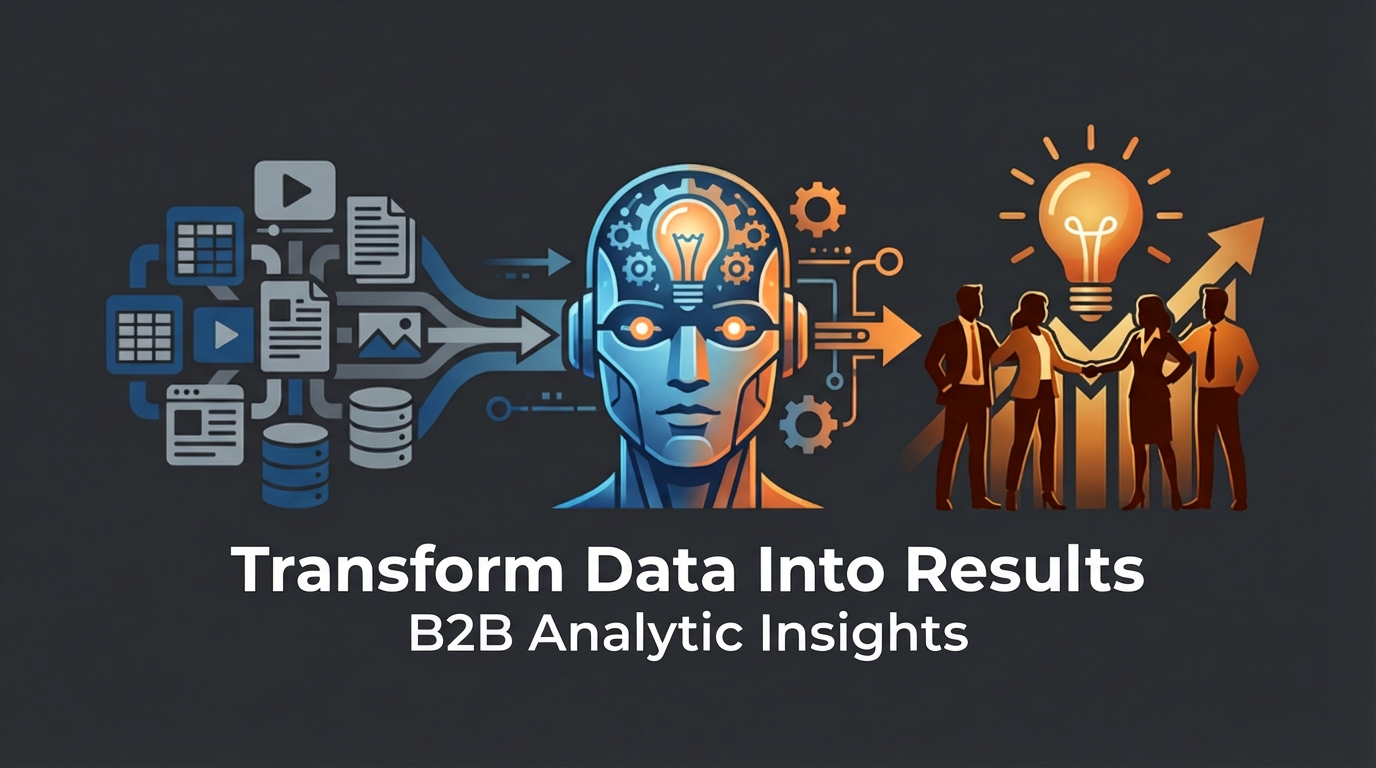

The insurance industry, historically reliant on actuarial tables and human intuition, is experiencing a tectonic shift. For decades, credit risk assessments, financial analysis, and enterprise operations in insurance underwriting have been rooted in rules-based systems. These methods, while foundational, often led to conservative pricing, missed opportunities, and slower response times. Now, with the advent of AI analytics, we’re witnessing an unprecedented opportunity to redefine risk assessment, moving from a reactive stance to a truly proactive, predictive paradigm. This isn’t just about incremental improvements; this is about an analytics transformation that fundamentally reshapes how insurers operate, improve profitability, and serve their clients.
The commercial landscape demands agility and precision. In B2B insurance, where complex risks and substantial premiums are the norm, archaic underwriting processes are a liability. We’re talking about lost revenue, inefficient capital allocation, and ultimately, a diminished competitive edge. The problem statements are stark: How do we accurately price highly bespoke risks? How do we accelerate the time-to-insight for complex portfolios? And critically, how do we empower our human underwriters to focus on strategic decision-making rather than repetitive data grunt work?
Legacy Underwriting: The Bottleneck in Growth
Traditional underwriting, often characterized by manual data aggregation, subjective assessments, and a heavy reliance on historical trends, presents significant limitations. The core issue is scalability and consistency. As per WTW’s 2026 survey, North American P&C insurers already leveraging advanced analytics and AI are reporting stronger profitability and premium growth. This isn’t a coincidence; it’s a direct correlation. The legacy approach struggles with the sheer volume and velocity of modern data, leading to a significant drag on efficiency and an inability to fully capitalize on new market opportunities. We’ve seen, time and again, how a lack of sophisticated analytical capabilities can directly impact a company’s bottom line, delaying policy issuance and hindering competitive pricing.
The Rise of Predictive Risk Scoring
The shift from purely rules-based underwriting to predictive risk scoring is perhaps the most profound change AI brings. Instead of simply checking boxes, machine learning models are now combining vast swathes of historical and real-time data to estimate claim probability, severity, and crucially, to price policies with unprecedented precision. This isn’t about replacing human judgment; it’s about augmenting it with data-driven insights that were previously unattainable. The ability to integrate diverse datasets – from macroeconomic indicators to individual risk profiles – into a cohesive predictive model allows for a truly granular understanding of risk, leading to more accurate premiums and a healthier claims ratio. This precision directly impacts our capacity to deliver greater value for shareholder capital employed in writing risk.
In the evolving landscape of insurance underwriting, the integration of AI analytics is transforming traditional risk assessment methodologies. A related article that delves deeper into this topic is available at B2B Analytic Insights, where it explores how advanced data analytics tools are enhancing decision-making processes and improving accuracy in evaluating potential risks. This resource provides valuable insights into the future of underwriting in the insurance industry, highlighting the significant role of technology in shaping effective risk management strategies.
AI’s Multi-faceted Impact on Underwriting Intelligence
The implementation of AI analytics is not a monolithic solution. It’s a suite of advanced technologies working in concert to enhance every stage of the underwriting process, from initial risk assessment to portfolio management. The gains are tangible, measurable, and directly contribute to key business objectives.
Leveraging Unstructured Data with Generative AI
One of the most exciting advancements lies in Generative AI’s ability to extract insights from unstructured data. Think about the rich, yet often inaccessible, information contained within medical records, property images, and even incident reports. Previously, manually sifting through these documents was a time-consuming and often inconsistent process. Now, Generative AI can rapidly process and synthesize this information, identifying critical risk factors and accelerating the underwriting cycle. This capability significantly improves consistency in risk evaluation, reducing variability in decision-making and allowing for a more standardized, yet nuanced, approach to even the most complex cases. For example, in property risk assessment, new AI products like LexisNexis Risk Solutions’ Location Intelligence for Home are explicitly designed to improve home insurance risk evaluation and underwriting accuracy.
Enhancing Specialized Underwriting Domains
The application of AI isn’t limited to general P&C. Life and health underwriting, for instance, is seeing substantial upgrades. Solutions like Sixfold’s new features for condition-based insights, core clinical data analysis, and discrepancy scanning are revolutionizing how medical information is analyzed. This translates to faster and more consistent evaluations, streamlining a process traditionally burdened by manual review and potential human error. In commercial lines, brokers and carriers are embracing AI-enhanced models. Hiscox is rolling out its AI-Enhanced Lead underwriting model to London market brokers, and NEXT Insurance has partnered with ZestyAI to integrate AI into small-business underwriting. These examples demonstrate that AI is not a niche technology; it’s becoming an integral part of operations across the entire insurance ecosystem.
In the evolving landscape of insurance underwriting, the integration of AI analytics is proving to be a game changer in how risk assessment is conducted. A related article discusses the transformative impact of machine learning on underwriting processes, highlighting how these technologies enhance decision-making and improve accuracy. For more insights on this topic, you can explore the article on AI in insurance, which delves deeper into the ways data-driven approaches are reshaping the industry.
Operational Efficiency: Speeding Up the Underwriting Cycle
The main operational gain from AI in underwriting is unequivocally speed. AI is dramatically reducing the underwriting cycle time by automating data ingestion, synthesis, and decision support functions. This frees up human underwriters to focus on what they do best: applying their deep expertise to complex, high-value risk evaluations, rather than getting bogged down in administrative tasks. This increase in efficiency directly translates into a competitive advantage. Imagine the ability to turn around a complex commercial policy in half the time, while simultaneously improving accuracy. That’s a game-changer for client satisfaction and market responsiveness. This isn’t merely about accelerating a process; it’s about reallocating human capital to higher-order cognitive tasks, leading to strategic rather than tactical decision-making.
Navigating the Challenges and Maximizing Opportunity

While the potential of AI in underwriting is undeniable, it’s crucial to acknowledge the challenges and set realistic expectations. This isn’t a silver bullet; it’s a powerful tool that requires careful implementation, organizational change management, and a continued focus on human oversight.
Bridging the Confidence Gap
Industry leaders recognize that AI improves underwriting quality and fraud detection, yet confidence and operational maturity still lag. A 2024 Capgemini-linked finding cited in Finance Yahoo noted that only 8% of P&C insurers were “underwriting pioneers.” This highlights a significant gap between recognition of AI’s potential and its widespread, confident adoption. The challenge here isn’t just technological; it’s cultural. Many organizations are still grappling with integrating AI into existing workflows, ensuring data governance, and building trust in algorithmic recommendations. It requires a strategic approach that combines technology investment with robust training programs for human underwriters, ensuring they understand, validate, and ultimately embrace AI as a co-pilot, not a replacement.
The Journey to Analytics Maturity
Achieving true analytics transformation requires a phased approach. It begins with establishing a robust data foundation, ensuring data quality, accessibility, and integration across disparate systems. Without clean, reliable data, even the most sophisticated AI models will falter. The next step involves building and deploying predictive models, iteratively refining them based on performance and new data. This is where organizations move from descriptive analytics—what happened—to predictive—what will happen—and ultimately to prescriptive—what should we do about it. The goal is to move from a state where only 16% currently use AI to augment human underwriting to a future where 60% plan to prioritize it by 2028, as reported by WTW. This acceleration demands investment in data infrastructure, MLOps capabilities, and a continuous learning culture.
Strategic Recommendations for C-suite and Analytics Leaders

For C-suite executives focused on ROI and analytics leaders driving implementation, the path forward is clear: strategic investment coupled with organizational transformation. We’re not just discussing technology deployment; we’re talking about a fundamental shift in how risk is perceived, quantified, and managed.
Invest in Data Infrastructure and Governance
The bedrock of any successful AI initiative is high-quality data. Prioritize investment in robust data lakes, data warehousing solutions, and advanced data governance frameworks. This ensures data integrity, accessibility, and compliance, which are non-negotiable for building trustworthy AI models. Without a solid data foundation, AI efforts will be hampered, leading to questionable insights and a lack of confidence among decision-makers.
Develop a Hybrid Underwriting Model
The future of underwriting is not purely automated; it’s a powerful synergy between human expertise and AI. Design a hybrid model where AI handles data ingestion, initial risk scoring, and identifies potential red flags, allowing human underwriters to concentrate on complex cases, client relationships, and strategic portfolio management. This maximizes the strengths of both, leading to superior outcomes. Train your teams not just in the “how” but the “why” of AI recommendations, fostering a culture of informed critique and continuous improvement.
Prioritize Explainable AI (XAI)
For AI models to gain trust and be adopted en masse, they must be explainable. Invest in XAI techniques that allow underwriters to understand the rationale behind AI-driven recommendations. This transparency is crucial for regulatory compliance, auditability, and building confidence within the underwriting team. It ensures that the black box isn’t so black after all, providing the necessary visibility for human oversight and intervention when required.
Establish a Culture of Continuous Learning and Iteration
The AI landscape is evolving rapidly. Foster a culture of continuous learning within your analytics and underwriting teams. Encourage experimentation, rapid prototyping, and iterative model development. This agile approach ensures that your organization remains at the forefront of AI innovation, adapting to new data sources, emerging risks, and evolving market demands. This includes cross-functional collaboration, ensuring that practitioners have the technical depth to implement and maintain these systems, while analytics leaders ensure alignment with strategic objectives.
In conclusion, AI analytics is not merely an enhancement for insurance underwriting; it is a catalyst for fundamental transformation. By strategically leveraging AI’s capabilities for predictive risk scoring, unstructured data analysis, and operational efficiency, insurers can unlock unprecedented levels of precision, speed, and profitability. This journey demands thoughtful investment, robust implementation, and a clear vision for a future where human ingenuity and artificial intelligence collaborate to redefine risk assessment, driving superior outcomes for businesses and their clients. The time for analytics transformation is now, not as an academic exercise, but as a critical business imperative.