
Why 2027 planning has to start with what we cannot predict.
In late 2019, the conversation in every planning room sounded the same. We had gone more than 120 months without a recession. Ten years of straight growth. The only real debate was which small thing would finally end it.
Then the surprise arrived, and it was not in anyone’s scenario model.
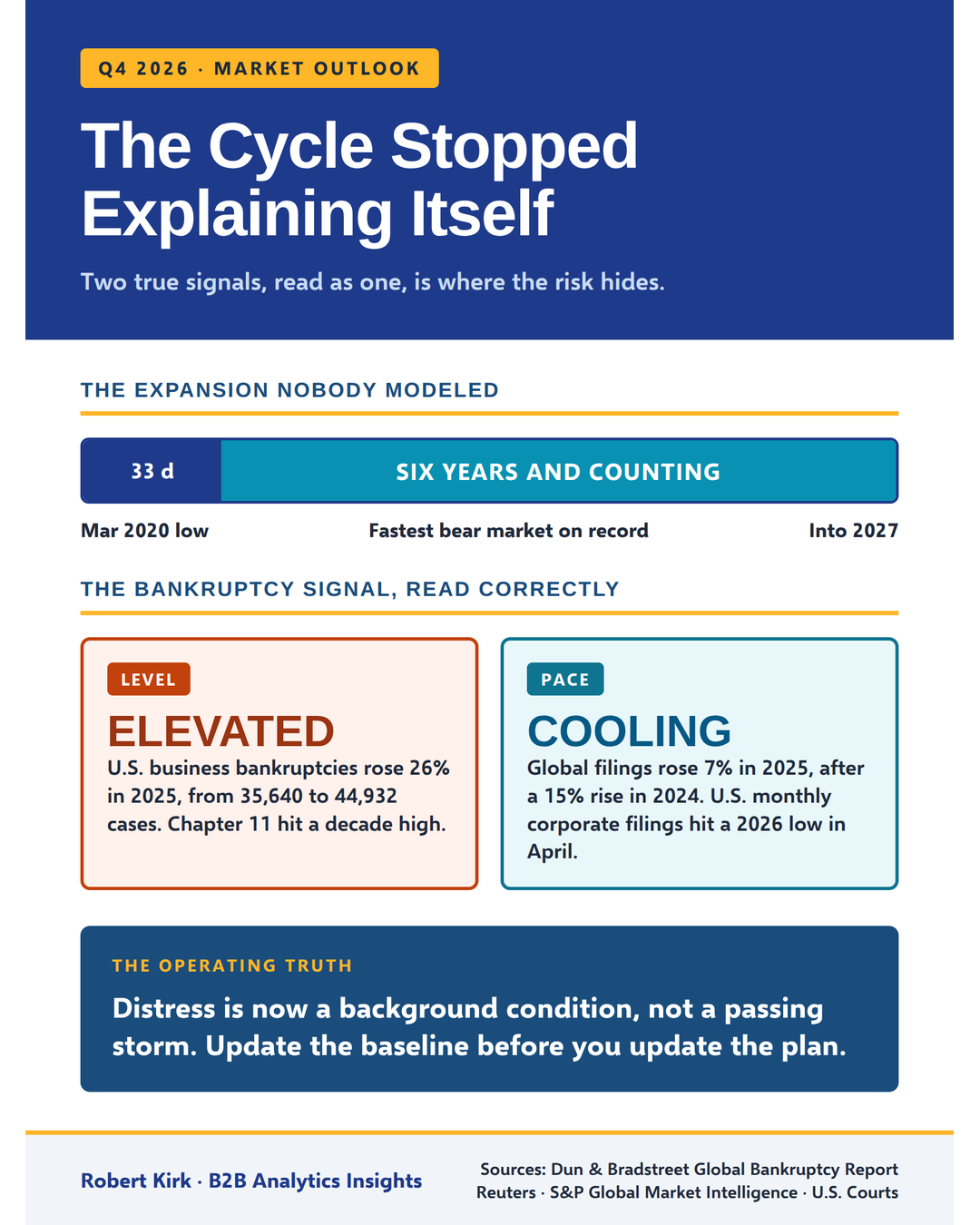
COVID delivered one quarter of chaos. Markets fell about 34 percent in roughly a month, the fastest bear market on record at 33 days from peak to trough. And then, before most models had finished updating, the recovery began. By August 2020 the S&P 500 was back at record highs.
That is the moment worth revisiting, because it taught all of us the wrong lesson. We learned that shocks are short. We learned that markets heal fast. We learned that the cycle bends and then snaps back.
Now we sit in Q4 of 2026, and the rulebook is not cooperating.
Six years in, and nobody’s model expected it
We are approaching six years of expansion from the March 2020 low. By the standards of the last several decades, this should be late. By the standards of the data in front of us, it is still moving.
S&P 500 earnings are projected to grow. The index is on track for a fourth straight year of gains. And yet the ground beneath the numbers is shifting in ways the headline figures do not capture.
This is the part that makes the current moment genuinely hard. The good news is real. The stress is also real. Both are true at the same time, and that is what chaos actually looks like in a market.
The bankruptcy signal we are reading wrong
Here is a place where precision matters more than narrative.
Business bankruptcies did not quietly go away. In the United States, filings rose 26 percent in 2025, from 35,640 to 44,932 cases. Every quarter of that year exceeded its 2024 counterpart. Chapter 11 filings reached a decade high. Across the 45 economies Dun & Bradstreet monitors, filings rose 7 percent.
But read the second half of that sentence. The 7 percent rise in 2025 followed a 15 percent rise in 2024. The pace is cooling. U.S. corporate bankruptcies hit a monthly low of 50 in April 2026. The levels remain elevated, and the rate of increase is moderating.
An elevated level and a slowing pace are not the same signal. A leader who hears “slowing” and relaxes gets the exposure wrong. A leader who hears “elevated” and freezes gets the opportunity wrong. The correct read is that financial distress is now a structural feature of the market, not a passing storm.
That is a different world than 2019. Back then, distress was rare enough to be an exception. Today it is a background condition. And background conditions are exactly what most monitoring systems are built to ignore.
Three layers of chaos, stacked on top of each other
The reason this cycle is disorienting is that three separate stories are running at once, and they do not agree.
The capital layer. AI is being built with debt at a scale the market has not absorbed before. Goldman Sachs estimates roughly one third of AI capital spending will be debt financed in 2026. PIMCO places the five largest hyperscalers’ capex near $690 billion for 2026 and $870 billion for 2027. AI related debt has become a meaningful share of investment grade issuance. This is expansive, and it is also concentrated.
The policy layer. Tariff policy remains a live variable, pressuring input costs and complicating planning across consumer goods and industrials. On top of that, the 2026 midterms may reshape control of Congress, raising the odds of divided government and near term volatility.
The consumer layer. The economy is splitting. Affluent households continue to sustain overall spending. Middle and lower income households show rising strain, elevated delinquencies, and a value conscious posture. PwC describes this as a K-shaped economy, and it is visible in the data.
When those three layers disagree, the aggregate numbers stay calm while the underlying risk moves. That is the definition of a market that looks fine and feels wrong.
The midterms will not end the uncertainty
There is a tempting story that the election resolves the question. It does not.
PwC’s framing is the honest one. The midterms will not end uncertainty. An election changes which uncertainty you carry, not how much. Affordability is shaping up to be the defining issue, and cost pressure is the bridge between the political conversation and the financial one.
For a finance leader, the practical takeaway is simple. Do not build a plan that requires a political outcome to work. Build a plan that survives several.
Why chaos is not a reason to freeze
The instinct in an uncertain market is to wait. Wait for clarity on rates. Wait for the election. Wait for the AI capital cycle to sort itself out. Wait for a signal that the turn is coming.
Waiting is the most expensive decision available, because it converts uncertainty into a single unhedged bet: the bet that nothing changes until you are ready.
What actually works is narrower and more useful. You cannot predict the turn. You can shorten the distance between a change and your response to it.
The next profitable decision
Every layer of this chaos eventually reaches a financial decision. That is the connective tissue across all of it.
– The capital layer lands on your cost of funds and your counterparties’ cost of funds.
– The policy layer lands on your input costs, your pricing, and your margin.
– The consumer layer lands on your receivables, your payment timing, and your cash conversion.
The question is not “what is happening in the market.” The question is: what does this cost, what does this risk, and how does it move cash flow across every relationship we hold?
That is where internal knowledge meets external insight. Internal knowledge is what your team already knows. Payment history you have collected. Portfolio behavior you have observed. Ground truth from your own accounts. External insights are what the market can see that you cannot see alone. Entity verification. Payment patterns across the economy. Scaled predictive models.
Alone, each side is a partial view. Combined, they become something you can act on.
What to do before 2027 planning closes
Three moves, none of which require a forecast.
First, re-baseline what “normal” means. If your risk thresholds were set in a low default environment, they are calibrated to a market that no longer exists. Elevated distress is the new baseline. Update the baseline before you update the plan.
Second, shorten the signal to action loop. Pick one critical counterparty or exposure. Find the last time something changed. Ask who saw it, what they did, and how long it took. If the answer is vague, the gap is your real risk, not the counterparty.
Third, plan for several futures, not one. Scenario planning is not pessimism. It is the discipline of knowing what you would do before you have to do it. The companies that handled 2020 well were not the ones that predicted a pandemic. They were the ones who could move quickly once the world changed.
The real lesson of 2020
We spent a decade watching for the wrong thing. We watched for the recession that would announce itself. Then a shock arrived that no one modeled, lasted one quarter, and left the market higher than before.
The lesson was never that shocks are short. It was that the world can change faster than our systems can notice.
2027 planning should start there. Not with a prediction, and not with a hope that things settle. It should start with the honest admission that uncertainty is the operating environment, and that the advantage goes to whoever can see change sooner and act on it earlier.
Internal Knowledge + External Insights = Competitive Intelligence. That is your Decision Intelligence Framework.
What is the one signal you wish your organization noticed earlier? I would genuinely like to hear how other leaders are answering that heading into 2027.