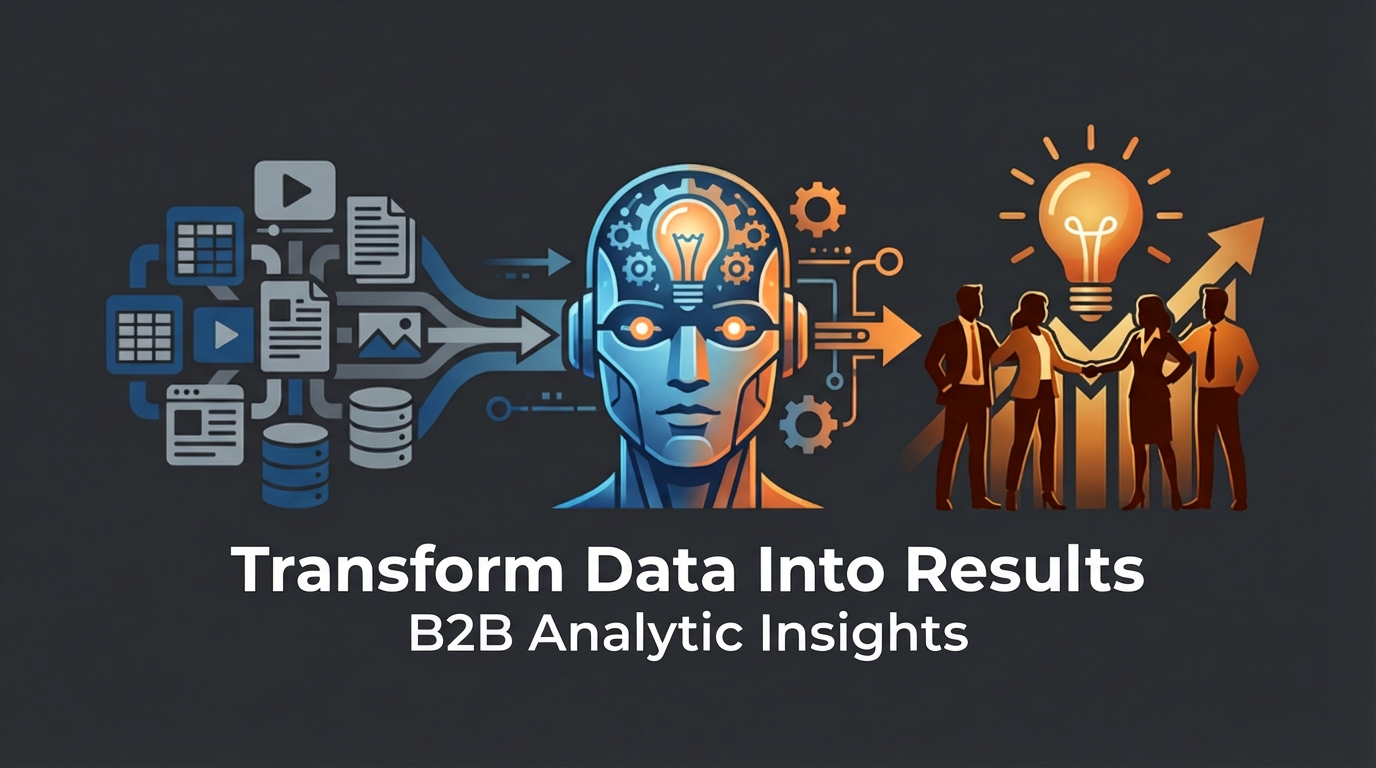

The landscape of B2B credit risk management is undergoing a seismic shift, driven by the accelerating adoption of AI analytics. For too long, credit departments have operated on a foundation of historical data, manual processes, and often, gut instinct. This has led to slower decisions, missed opportunities, and ultimately, higher levels of credit loss. The imperative is clear: transform how we assess and manage risk or risk becoming irrelevant. This isn’t about incremental improvements; it’s about a fundamental analytics transformation that elevates data-driven decision-making from a goal to a daily reality. We’re not just talking about predictive models; we’re talking about decision intelligence.
The challenges are significant. The sheer volume and complexity of financial data, coupled with the dynamic nature of global markets and individual business performance, create a perpetual fog of uncertainty. Traditional credit scoring models, while valuable, struggle to keep pace with the velocity of change and the nuanced qualitative factors that often precede significant credit events. This is where AI analytics steps in, offering a powerful toolkit to cut through the noise and illuminate the path to smarter, faster, and more accurate financial decisions. The goal is to achieve a dramatically improved time-to-insight, enabling proactive risk mitigation and strategic growth.
The Evolving Imperative for B2B Credit Risk Management
The financial services industry, by its very nature, is risk-averse. However, an overly cautious approach can stifle innovation and limit growth. We must strike a delicate balance. The traditional, often paper-driven, credit application and assessment process can take weeks, if not months. In today’s fast-paced B2B environment, where deals can materialize and evaporate with remarkable speed, this glacial pace is a significant competitive disadvantage. Companies are already recognizing this; a recent Provenir survey indicates that 60% of credit risk and fraud executives plan to invest in AI/Decision Intelligence in the near future, with 77% already deeming it very valuable for their long-term strategy. This isn’t a future trend; it’s a present-day mandate.
The Cost of Delayed Decisions
The financial implications of delayed credit decisions extend far beyond lost sales.
- Lost Revenue Opportunities: Inability to quickly approve credit lines for promising new clients or to expedite existing ones can directly translate into lost revenue. Deals that require swift financing often go to more agile competitors.
- Competitive Disadvantage: Market share is influenced by responsiveness. Slow credit processes tell potential partners that you are not agile enough for their business needs.
- Increased Operational Inefficiency: Manual data gathering, analysis, and approval workflows consume valuable employee time that could be redirected to higher-value strategic activities. We’re talking about significant FTE drain on manual tasks that AI can automate.
The Shifting Definition of Risk
Risk is no longer just about a company’s balance sheet. It encompasses a multitude of factors, from macroeconomic shifts to reputational damage and supply chain disruptions. Traditional models often fail to capture these dynamic, often unstructured, influences. The complexity demands a more sophisticated approach, one that can synthesize diverse data streams and identify emergent risks before they become critical. This is where AI’s ability to process and learn from vast, heterogeneous datasets becomes indispensable.
In the realm of B2B credit risk management, the integration of AI analytics is proving to be a game-changer for financial decision-making. A related article that delves deeper into this transformation is titled “The Power of Analytics: Transforming Data into Meaningful Actions.” This piece explores how businesses can leverage advanced analytics to derive actionable insights from their data, ultimately enhancing their financial strategies and risk assessment processes. For more information, you can read the article here: The Power of Analytics: Transforming Data into Meaningful Actions.
AI Analytics: The Engine Driving Modern Financial Decision-Making
AI analytics is not a buzzword; it’s a tangible set of technologies and methodologies that are fundamentally reshaping how financial institutions and B2B enterprises approach credit risk. It offers the ability to move beyond reactive analysis to proactive, predictive, and prescriptive insights. The key lies in its capacity to process data at speeds and scales unimaginable with traditional methods, uncovering patterns and correlations that would otherwise remain hidden. This fuels a significant acceleration in our time-to-insight, a critical metric in any dynamic business environment.
The Spectrum of AI Applications in Credit Risk
The application of AI in B2B credit risk is broad and impactful, touching upon numerous critical functions within the financial decision-making process.
- Fraud Detection: This is a leading use case, with the Provenir survey noting that 43% of credit risk and fraud executives are leveraging AI for this purpose. AI algorithms can identify anomalous transaction patterns, synthetic identities, and other sophisticated fraud schemes with greater accuracy and speed than manual reviews.
- Automated Credit Decisioning: AI-powered systems are automating significant portions of the credit decision workflow. This ranges from initial data ingestion and verification to a preliminary risk assessment, allowing human analysts to focus on the more complex and exception-based cases. This directly impacts the time-to-insight.
- Enhanced Underwriting: Beyond simply checking boxes, AI can analyze a broader array of data, including alternative data sources and unstructured text, to provide a more comprehensive and nuanced view of a borrower’s creditworthiness. This is where Generative AI is making inroads, as noted by McKinsey, capable of reviewing documents, flagging policy issues, and drafting credit memos.
- Portfolio Monitoring and Early Warning Systems: AI can continuously monitor entire loan portfolios, flagging subtle shifts in borrower behavior or market conditions that might indicate escalating risk. This proactive approach allows for timely intervention, potentially preventing defaults.
Bridging Technical Concepts to Business Value
It’s crucial to translate the technical prowess of AI into quantifiable business outcomes. For instance, a 40% improvement in the speed of risk decisioning workflows, as reported in the Provenir survey, directly translates into faster customer onboarding, increased sales conversion rates, and improved customer satisfaction. Similarly, a 31% focus on reducing credit losses and boosting collections recovery through AI signifies a direct impact on the bottom line. These are not abstract benefits; they are concrete ROI drivers.
Real-Time Credit Decisions: The New Standard for Agility
The demand for speed in B2B transactions is insatiable. Customers expect immediate responses, and credit departments are finally catching up. The concept of real-time credit decisions is no longer a ‘nice-to-have’; it’s a strategic imperative for staying competitive. The ability to provide instant credit assessments across all customer touchpoints is a high-value AI feature, with 49% of executives citing it as crucial. This transformation is moving beyond quarterly reviews to dynamic, moment-of-need assessments that redefine engagement.
The Impact of Instant Insights
The benefits of real-time credit decisioning are manifold and directly impact key business metrics.
- Accelerated Sales Cycles: Imagine a salesperson being able to get an instant credit decision for a potential client at the point of sale. This removes a significant bottleneck, closing deals faster and capturing revenue while competition is still analyzing. This is a direct enhancement of data-driven decision making.
- Improved Customer Experience: Customers value efficiency. Receiving a quick and accurate credit decision fosters trust and loyalty, distinguishing your organization from slower, more bureaucratic competitors.
- Dynamic Risk Management: Real-time data allows for continuous assessment of risk. As market conditions or a client’s financial situation changes, AI can flag this instantly, enabling proactive adjustments to credit lines or terms.
Enabling Technologies for Real-Time Assessment
This level of speed is only possible with advanced technological capabilities.
- APIs and Data Integration: Seamless integration of disparate data sources through APIs is fundamental. This allows for the real-time flow of information from customer relationship management (CRM) systems, financial data providers, and internal databases.
- Stream Processing: AI models capable of processing data in motion are essential for real-time analytics. This means analyzing data as it arrives, rather than in batches, enabling immediate insights.
- Cloud-Native Architecture: Scalable, cloud-based solutions provide the necessary infrastructure to handle the computational demands of real-time AI processing.
Advanced AI Tools: From Manual Analysis to Cognitive Insights
The tools themselves are evolving at an unprecedented pace. We’ve moved beyond basic machine learning models to sophisticated AI agents that can interact with complex financial documents and generate actionable insights in what feels like a blink of an eye. This is a significant leap from the hours or days it took for human analysts to perform the same tasks manually. The efficiency gains and accuracy improvements are staggering.
The Power of Document Understanding
The ability of AI to digest and interpret unstructured data, particularly financial documents, is a game-changer.
- Rapid Financial Statement Analysis: Tools like martini.ai’s Financials Agent exemplify this trend. Users can upload 10-Ks, financial statements, or annual reports, and within minutes, receive AI-generated credit insights. This dramatically reduces the time-to-insight for credit analysts.
- Extraction of Key Metrics: AI can accurately extract critical financial ratios, performance indicators, and risk factors from dense documents, presenting them in an easily digestible format. This automates a highly time-consuming manual task.
- Identification of Red Flags: AI can be trained to identify subtle anomalies, inconsistencies, or cautionary language within financial reports that might signal underlying financial distress or potential fraud.
Generative AI’s Entry into Underwriting
Generative AI is no longer just about crafting marketing copy; it’s entering the core of financial decision-making. McKinsey’s observation that GenAI can review documents, flag policy issues, and draft credit memos highlights its potential to augment the underwriting process significantly.
- AI-Assisted Credit Memo Creation: Instead of starting from a blank page, underwriters can leverage GenAI to draft initial credit memos, summarizing key findings, risks, and recommendations. This frees up their time for more critical analysis and strategic thinking.
- Policy Compliance Checking: GenAI can be used to scan loan applications and supporting documents to ensure compliance with internal credit policies and regulatory requirements, reducing the risk of human error.
- Scenario Planning and Simulation: While still emergent, GenAI holds potential for simulating various economic scenarios and their impact on borrower portfolios, providing data-driven insights for stress testing and risk mitigation strategies.
In exploring the impact of AI on financial decision-making, it’s essential to consider how businesses can effectively manage B2B credit risk. A related article discusses innovative strategies for leveraging AI analytics to enhance credit evaluations and streamline the decision-making process. For more insights on this topic, you can visit this page to discover how advanced analytics can transform your approach to financial risk management.
Beyond Speed: Enhancing Accuracy and Monitoring in B2B Credit
While speed is a compelling benefit, it’s the enhancement of accuracy and the capability for continuous monitoring that truly solidify AI’s transformative power in B2B credit risk. This means fewer errors, more precise risk assessments, and the ability to detect emerging issues before they escalate into significant problems. These improvements directly contribute to reduced credit losses and greater financial stability for the organization. This is the essence of data-driven decision making.
Automated Financial Document Analysis
The days of manually poring over spreadsheets and financial reports are diminishing. AI is now capable of performing sophisticated financial document analysis with remarkable accuracy.
- Automated Ratio Calculation and Trend Analysis: AI can instantly calculate key financial ratios and identify trends over time, providing a faster and more consistent assessment of financial health. This eliminates the potential for human calculation errors.
- Benchmarking Against Industry Peers: AI can effectively benchmark a company’s financial performance against industry averages, identifying areas where the company is performing exceptionally well or lagging behind. This provides crucial context for risk assessment.
- Anomaly Detection in Financial Data: AI algorithms excel at identifying outliers and unusual patterns within financial statements that might indicate accounting irregularities, fraud, or impending financial distress.
Early Delinquency Detection and Proactive Intervention
The cost of late payments is substantial, impacting cash flow and potentially leading to write-offs. AI analytics offers a powerful solution for early detection and proactive intervention.
- Predictive Delinquency Scoring: By analyzing a wide range of data, including payment histories, macroeconomic indicators, and even news sentiment, AI can predict the likelihood of a borrower becoming delinquent before it actually happens. This allows for proactive engagement.
- Automated Communication and Collection Workflows: Once a potential delinquency is flagged, AI can trigger automated communication workflows, offering flexible payment options or escalating the case for human intervention based on predefined rules. This streamlines collections and improves recovery rates.
- Behavioral Analysis: AI can analyze changes in a customer’s payment behavior, such as increased late payments or reduced transaction volumes, to identify potential financial difficulties early on.
Continuous Risk Monitoring and Broader Business Contextualization
Risk is not static; it’s a dynamic, ever-evolving landscape. AI analytics enables organizations to move from periodic risk assessments to continuous monitoring, integrating a wider array of business context.
- Real-Time Market Sentiment Analysis: AI can monitor news, social media, and industry reports to gauge market sentiment and identify potential disruptions that could impact a borrower’s ability to repay.
- Supply Chain Risk Assessment: By analyzing data related to a borrower’s key suppliers and customers, AI can identify potential vulnerabilities within their extended supply chain that could lead to financial strain.
- Geopolitical and Regulatory Risk Tracking: AI can monitor global and regional events that may have implications for a borrower’s operations or financial stability, providing a more holistic view of risk. This is crucial for global B2B operations.
The Human Element: Augmentation, Not Replacement
It’s essential to address the elephant in the room. The rise of AI analytics in B2B credit risk management does not signal the obsolescence of human expertise. Instead, it signifies a profound augmentation. AI excels at processing vast datasets, identifying patterns, and automating routine tasks with unparalleled speed and accuracy. Human analysts, however, bring critical thinking, contextual understanding, ethical judgment, and relationship management skills that AI cannot replicate. The future lies in a symbiotic relationship where technology empowers people to make better decisions.
Redefining the Analyst Role
The role of the credit analyst is evolving from data entry and manual calculation to strategic analysis and complex problem-solving.
- Focus on High-Value Analysis: With AI handling routine tasks, analysts can dedicate more time to complex credit structures, negotiation, strategic risk mitigation, and building stronger relationships with clients.
- Interpretation and Strategic Insight: Analysts will be tasked with interpreting the insights generated by AI, understanding the underlying drivers, and translating them into actionable strategies for the business. They become the bridge between the data and the decision.
- Domain Expertise Application: Domain expertise remains critical. Analysts’ deep understanding of industries, markets, and business models is essential for validating AI outputs and making nuanced judgments in complex situations.
The Importance of Change Management and Training
Successfully integrating AI into credit risk operations requires a robust change management strategy. This involves not just implementing new technology but also upskilling the workforce and fostering a culture of data-driven decision making.
- Comprehensive Training Programs: Employees need to be trained not only on how to use the new AI tools but also on how to interpret their outputs and integrate them into their daily workflows.
- Cultivating a Data-Driven Culture: Organizations need to foster an environment where decisions are consistently informed by data and analytics, encouraging curiosity and a willingness to challenge existing assumptions.
- Ethical Considerations and Governance: Establishing clear ethical guidelines and governance frameworks for AI usage in credit risk is paramount. This includes addressing potential biases in algorithms and ensuring fairness and transparency in decision-making.
Technology and Human Expertise: A Synergistic Partnership
The most effective approach to AI in credit risk is a partnership. AI provides the engine for speed and scale; humans provide the intelligence and judgment.
- AI as a Co-Pilot: Think of AI as an incredibly powerful co-pilot for credit analysts, handling the heavy lifting of data processing and initial analysis, allowing the human pilot to focus on navigation and strategic decision-making.
- Human Oversight and Validation: AI outputs should always be subject to human oversight and validation, especially in critical decision-making processes. This ensures that decisions are not only data-backed but also strategically sound and ethically defensible.
- Continuous Learning Loop: The insights gained from human analysts interacting with AI can be fed back into the AI models, creating a continuous learning loop that further refines the system’s accuracy and effectiveness over time.
Strategic Recommendations for Embracing AI in B2B Credit Risk
The transformation to AI-powered B2B credit risk management is not an option; it’s a necessity for survival and growth. It requires a strategic vision, a commitment to change, and a clear understanding of both the opportunities and challenges. For C-suite executives, the focus must be on ROI and strategic advantage. For analytics leaders, it’s about implementation and fostering adoption. For practitioners, it’s about leveraging the technology to enhance their expertise.
For C-Suite Executives: Drive ROI and Strategic Advantage
- Prioritize Analytics Transformation: View analytics transformation not as an IT project, but as a core business strategy. Allocate the necessary resources and leadership attention to embed data-driven decision-making across the credit function.
- Quantify the Value: Focus on measurable outcomes. Track metrics such as reduced credit losses (aiming for a X% reduction), increased sales conversion rates (Y% uplift), and improved customer satisfaction scores (Z points increase). This demonstrates tangible ROI.
- Champion a Data-Driven Culture: Lead by example. Encourage the use of data in all strategic discussions and decisions. Foster a culture where challenging assumptions based on data is rewarded.
For Analytics Leaders: Empower Implementation and Foster Adoption
- Develop a Phased Implementation Roadmap: Start with pilot projects targeting high-impact areas like fraud detection or automating credit memo generation. Demonstrate quick wins to build momentum and stakeholder buy-in.
- Focus on Integration and Data Governance: Ensure seamless integration of AI tools with existing systems. Establish robust data governance frameworks to ensure data quality, security, and ethical usage.
- Invest in Talent and Training: Hire data scientists and AI specialists, but equally important, invest heavily in upskilling your existing credit and finance teams. Practical training on how to use and interpret AI tools is crucial for adoption.
For Practitioners: Leverage Technology for Enhanced Expertise
- Embrace the Tools: View AI not as a threat, but as an opportunity to enhance your skills and effectiveness. Learn to leverage AI tools for faster data analysis, more accurate risk assessments, and proactive insights.
- Focus on Strategic Interpretation: Shift your focus from manual data manipulation to interpreting AI-generated insights, applying your domain expertise, and developing strategic recommendations for risk mitigation and business growth.
- Collaborate and Share Knowledge: Work closely with your IT and analytics teams. Share your domain expertise to help refine AI models and provide feedback on tool usability. Continuous learning and collaboration are key.
The journey of integrating AI analytics into B2B credit risk management is an ongoing one. It requires a commitment to innovation, a willingness to adapt, and a clear understanding that the most successful outcomes are achieved when technology and human expertise work in concert. By embracing this transformation, organizations can navigate the complexities of credit risk with greater confidence, unlock new opportunities, and secure a more robust and profitable future.