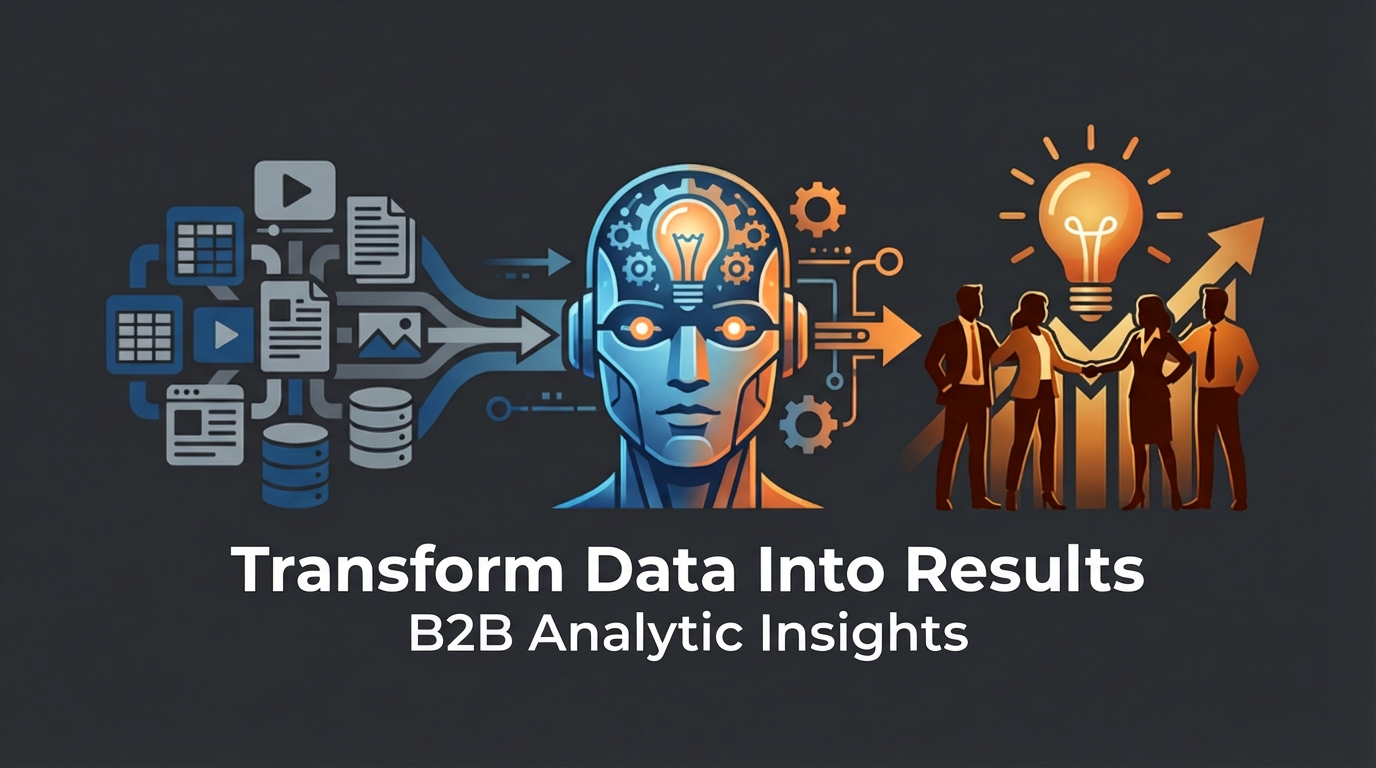

For decades, the promise of data has been dangled before businesses like a shimmering mirage. We’ve invested heavily in systems, tools, and talent, yet the consistent, tangible return on that investment has often remained elusive. This isn’t a new problem, but the current landscape, particularly with the rapid ascent of AI, demands a more rigorous, strategic approach to proving business impact and calculating ROI. The days of unbridled experimentation are over; the C-suite is now asking pointed questions about where every dollar is going and what tangible value it’s generating. This is not about hype; it’s about hard-won success through disciplined analytics transformation.
The Accelerating Demand for Proven AI ROI
The executive suite is no longer content with theoretical benefits or anecdotal success stories. The 61% of CEOs reporting increased pressure to demonstrate ROI on AI investments is not a mere statistic; it’s a seismic shift. This year, we’re witnessing a decisive move away from the exploratory phase of AI adoption. Enterprises are demanding measurable results, and ROI has firmly taken center stage as the primary metric of success. This isn’t just a cyclical trend; it reflects a fundamental maturation of how businesses are integrating advanced technologies. Planning cycles, once measured in years, are now accelerating to quarterly checkpoints, and even continuous reprioritization. This agility is critical, as the pace of technological change and market demands necessitates a constant evaluation of where our investments are yielding the greatest returns.
From Experimentation to Enterprise Deployment: The New Reality
The narrative of AI has been dominated by exciting proofs of concept and pilot programs. While these were essential for understanding potential, they are no longer sufficient. In 2026, the defining characteristic is the transition from these isolated experiments to enterprise-wide production deployments. This shift is underpinned by the maturation of essential infrastructure and governance frameworks. Think about it: the early days of cloud computing saw similar phases, moving from niche applications to core business operations. Similarly, AI’s journey is now firmly on the path to becoming an integrated, mission-critical component of business operations, from credit risk assessment to supply chain optimization.
The Maturation of AI Infrastructure
The underlying technological scaffolding for AI is no longer a nascent concern. Robust data pipelines, scalable computing resources, and secure data management practices are increasingly in place, enabling the reliable operation of AI models at scale. This isn’t just about having the latest hardware; it’s about building the resilient architecture that can support continuous AI model training, deployment, and monitoring. For instance, in financial services, a robust AI infrastructure allows for the real-time ingestion and processing of vast amounts of transactional data, crucial for effective fraud detection and credit scoring.
Governance and Ethical Frameworks as Enablers
A significant driver of this enterprise-wide deployment is the development of mature governance and ethical frameworks. These aren’t impediments to progress; they are enablers. Clear guidelines for data privacy, algorithmic fairness, and model interpretability build trust and reduce the risk associated with widespread AI adoption. When your credit risk models are demonstrably fair and transparent, you mitigate regulatory exposure and enhance customer relationships. This robust governance allows us to move beyond speculative applications and confidently embed AI into core operational workflows.
The Compounding Challenge of Measuring AI Value
Despite the growing pressure for AI ROI, a significant hurdle remains: measurement. AI ROI is notoriously difficult to quantify, particularly for technologies that enhance personal productivity. It’s easy to point to a chatbot resolving customer queries, but quantifying the ripple effect on employee productivity across the entire organization, or the subtle improvements in customer satisfaction that lead to increased lifetime value, is a far more intricate exercise. This disconnect between investment and verifiable return is why only a minority of companies are truly positioned to achieve meaningful ROI in 2026. These are typically organizations with clear, C-suite-level alignment on their technology strategies, where analytics is not an afterthought but a core driver of business.
The “Untethered” AI Spend Phenomenon
This measurement gap is starkly reflected in the projected increase in corporate AI spending. While estimates suggest a 30%+ surge in 2026, a concerning reality is that much of this investment remains “untethered to metrics or ROI.” This is a red flag. It suggests that many organizations are still investing based on market trends or competitive pressures rather than a clearly defined path to value generation. This is where our analytics transformation must become more incisive. We need to move beyond simply spending on AI to strategically investing with measurable outcomes in mind.
The Difficulty of Quantifying Productivity Gains
Consider the impact of AI-powered code generation tools for software development teams. They can demonstrably speed up development cycles. But how do we translate that velocity into specific business outcomes? Is it faster time-to-market for new products, reduced development costs, or an improved ability to respond to market shifts? Without a sophisticated attribution model that links developer productivity directly to product revenue or customer acquisition costs, the ROI remains nebulous. This is why embracing data-driven decision making is paramount; we need to define these linkages before we deploy the technology.
For those interested in understanding the intricate relationship between business impact and return on investment (ROI), a valuable resource can be found in the article on B2B Analytical Insights. This article delves into various strategies that businesses can employ to measure and enhance their ROI effectively. To explore this insightful piece further, you can visit the following link: Business Impact & ROI Insights.
The Tightening Timeline for Value Realization
The era of lengthy implementation cycles for analytics initiatives is rapidly fading. Value delivery expectations have compressed significantly, with many organizations now aiming for discernible impact within 4-6 month cycles. This compressed timeline exerts immense pressure on analytics teams and mandates a strategic prioritization of initiatives that can demonstrate rapid, tangible benefits. The days of multi-year analytics projects with delayed payoffs are being replaced by a demand for agility and quick wins that can build momentum and justify further investment.
Accelerating Value Through Iterative Deployment
This compressed timeline necessitates an iterative approach to AI and analytics deployment. Instead of aiming for perfect, all-encompassing solutions from the outset, the focus shifts to delivering incremental value quickly and then refining the solution based on real-world performance. This means breaking down large, complex projects into smaller, manageable phases, each designed to deliver a specific, measurable outcome. For example, in customer churn prediction, an initial model might focus on identifying the top 20% of at-risk customers, allowing for targeted retention efforts that can be measured within a few months. Subsequent iterations can then refine the model to improve its accuracy and expand its scope.
The Rise of Agile Analytics Frameworks
To support these accelerated timelines, agile analytics frameworks are becoming indispensable. These frameworks emphasize collaboration, rapid prototyping, and continuous feedback loops. They allow teams to adapt quickly to changing requirements and learn from user interactions. This is a stark contrast to traditional waterfall methodologies, which can be too rigid for the dynamic nature of analytics and AI development. The successful implementation of an analytics transformation hinges on adopting these more nimble approaches.
Measuring Success in Shorter Iterations
The success of these shorter cycles is measured not just by the technical performance of the models, but by their direct impact on key business metrics. Within these 4-6 month windows, we should be able to demonstrate improvements in areas such as customer acquisition cost reduction, operational efficiency gains, or increased revenue per customer. This immediate feedback loop is crucial for maintaining stakeholder buy-in and ensuring that analytics efforts remain aligned with overarching business objectives.
The PR and Marketing Imperative: Proving Impact is Survival
The pressure to demonstrate ROI is not confined to the finance department. It has become a critical imperative for PR and marketing teams. In 2026, an alarming nearly half of agency professionals anticipate communications budget cuts due to an inability to prove impact. This isn’t about vanity metrics like reach or impressions anymore. Social media ROI, for instance, is increasingly determined by attribution accuracy and deep analytics integration, rather than surface-level engagement. This forces a fundamental shift in how marketing efforts are designed, measured, and justified.
Beyond Reach: The New Era of Social Media ROI
The days of boasting about follower counts are over. The true measure of social media success lies in its ability to drive tangible business outcomes. This means linking social media engagement to lead generation, website traffic, customer conversions, and ultimately, revenue. This requires sophisticated attribution models that can accurately track the customer journey across multiple touchpoints, including social channels. For a B2B enterprise, this might mean proving how a targeted LinkedIn campaign contributes to qualified sales leads and closed deals, moving beyond simple engagement metrics to demonstrable pipeline impact.
Multi-Touch Attribution Models Driven by AI
To achieve this level of accuracy, companies are moving towards multi-touch, AI-based attribution models. These models acknowledge that a single customer journey rarely involves just one interaction. They analyze the entire sequence of touchpoints, assigning credit to each interaction based on its contribution to the final conversion. For instance, an AI model might determine that an initial awareness campaign on a trade publication website, followed by a targeted email series, and finally an engagement on social media, collectively contributed to a new enterprise software sale. This is a far cry from first-touch or last-touch attribution, offering a much more nuanced and accurate picture of marketing effectiveness.
The Credibility of PR in a Data-Driven World
For PR teams, proving impact is now directly tied to their credibility and, in some cases, their survival. The ability to articulate the business value of earned media, thought leadership campaigns, and corporate reputation initiatives through concrete metrics is no longer optional. This requires a close collaboration between PR professionals and analytics teams to establish clear KPIs, implement robust tracking mechanisms, and analyze the correlation between communication efforts and business performance, such as brand sentiment shifts impacting sales or investor relations.
The Strategic Imperative: Linking Analytics to Enterprise Operations
At the heart of achieving genuine business impact and ROI from analytics lies the imperative to seamlessly integrate these capabilities into core enterprise operations. This is about moving analytics from a specialized, siloed function to a pervasive element of how the business operates. For credit risk departments, this means embedding predictive models into the loan origination process. For operational leaders, it means using real-time analytics to optimize supply chain logistics and manufacturing workflows. This strategic linking is the differentiator between companies that simply use data and those that are truly powered by it.
Analytics Transformation as a Strategic Lever
Analytics transformation is not merely about acquiring new tools; it’s a fundamental shift in organizational strategy, culture, and processes. It’s about fostering a data-driven decision-making environment where insights derived from data are actively sought, understood, and acted upon at all levels. This transformation requires strong leadership commitment, clear communication of vision, and a willingness to disrupt traditional ways of working. Without this strategic framing, even the most advanced analytical capabilities will struggle to achieve their full potential.
Fostering a Data-Driven Culture
Building a data-driven culture is perhaps the most challenging, yet most crucial, aspect of this transformation. It involves equipping employees with the skills and confidence to engage with data, promoting data literacy across the organization, and encouraging a mindset where hypotheses are rigorously tested and decisions are evidence-based. This isn’t about turning everyone into a data scientist, but about empowering every professional to understand and leverage the data relevant to their role. For example, a sales manager should be able to interpret customer segmentation reports to refine their outreach strategies, not just defer to the analytics team.
Breaking Down Data Silos for Holistic Insights
A critical component of integrating analytics into enterprise operations is breaking down data silos. When data resides in disparate systems, it limits the scope and accuracy of analytical insights. True business impact is realized when we can construct a holistic view of our customers, operations, and financial performance. This often requires investing in data integration platforms, master data management solutions, and establishing clear data governance policies that ensure data quality and accessibility across the organization. For a B2B company, understanding the full customer lifecycle from marketing engagement to post-sales support requires a unified view of customer data.
In the ever-evolving landscape of business, understanding the impact of analytics on decision-making is crucial for maximizing ROI. A related article that delves deeper into this topic can be found at B2B Analytic Insights, where it explores how data-driven strategies can significantly enhance business performance and profitability. By leveraging insights from analytics, companies can make informed choices that lead to sustainable growth and improved financial outcomes.
Strategic Recommendations for Maximizing ROI
The path to demonstrating demonstrable business impact and achieving a strong ROI from analytics, particularly with the integration of AI, requires a deliberate and strategic approach. It’s not about hoping for the best; it’s about architecting for success.
First, prioritize clear, quantifiable KPIs from the outset. Before any analytics or AI initiative is launched, define precisely what success looks like in measurable terms. This goes beyond technical accuracy to linking model performance directly to specific business outcomes like revenue uplift, cost reduction, or risk mitigation. For credit risk, this might be a reduction in default rates by X% or an increase in loan approval velocity by Y%.
Second, embrace an iterative and agile deployment model. The compressed value delivery timelines demand this. Focus on delivering incremental value in 4-6 month cycles, learn from each iteration, and continuously refine your models and strategies. This allows for faster time-to-insight and quicker realization of benefits, building momentum and stakeholder confidence.
Third, invest in robust attribution and measurement frameworks. This is non-negotiable. Leverage multi-touch, AI-based attribution models to accurately understand the impact of various initiatives, especially in marketing and sales. For PR, establish clear metrics that link communication efforts to tangible business outcomes.
Fourth, drive analytics transformation through C-suite alignment and cultural change. Without executive sponsorship and a pervasive data-driven culture, even the most sophisticated analytics will remain an underutilized asset. Invest in data literacy, foster collaboration between business and analytics teams, and ensure that data-informed insights are embedded in day-to-day decision-making processes.
Finally, focus on enterprise-wide integration. Analytics and AI should not be confined to pilot projects or isolated departments. Strategically integrate these capabilities into your core enterprise operations, from financial analysis and credit risk assessment to supply chain management and customer experience. This holistic integration is where true, sustained business impact and a compelling ROI are achieved. The time for merely talking about data’s potential is past; the time for relentlessly proving its impact is now.