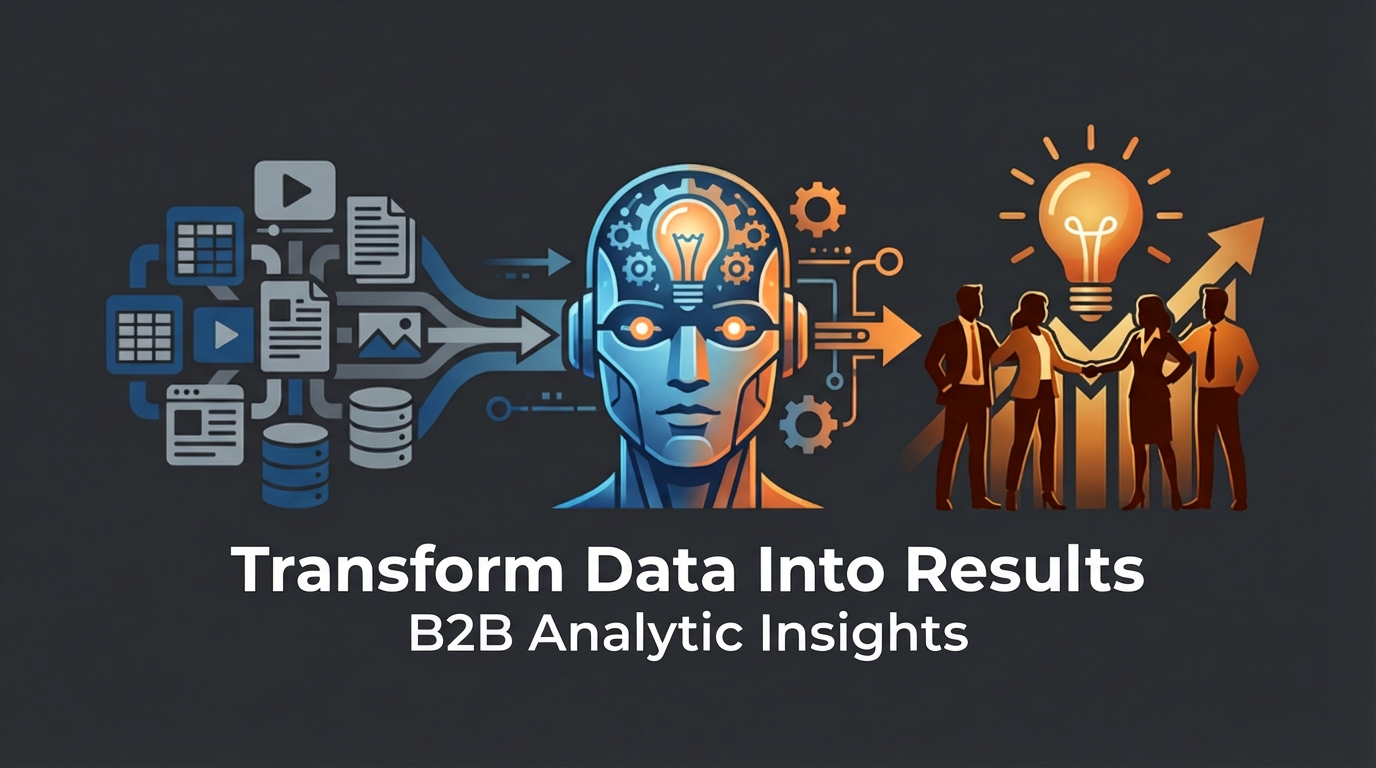

We’re living in a brave new world where data isn’t just a byproduct of operations; it’s the bedrock of competitive advantage. For two decades, I’ve seen organizations grapple with turning raw data into actionable intelligence. Today, with the surge in advanced analytics, particularly embedding models, the opportunity is immense. But let’s be clear: embedding models into your analytics workflows isn’t merely a technical exercise. It’s a strategic imperative, a fundamental shift in how we leverage data for critical B2B functions like credit risk assessment, financial analysis, and enterprise operational optimization.
The promise here is tantalizing: faster, smarter decisions, reduced operational costs, and unparalleled insights. The challenge? Implementing these models effectively, managing their lifecycle, and ensuring they truly drive value rather than just creating another layer of technical debt. This isn’t about chasing the latest shiny object; it’s about embedding intelligence where it matters most, streamlining your time-to-insight, and ultimately, delivering a quantifiable ROI.
The Strategic Imperative of Embedding Models in B2B Analytics
In high-stakes B2B environments, the stakes are uncomfortably high. A miscalculated credit risk can jeopardize billions. An inefficient supply chain costs millions annually. Traditional analytical approaches, while foundational, often struggle with the sheer volume and velocity of modern enterprise data. This is where embedding models shine, transforming disparate data points into rich, contextualized vectors that unlock deeper understanding.
Think about credit risk. Historically, we’ve relied on structured data: financial statements, credit scores, payment history. Embedding models allow us to incorporate unstructured data like news articles, social media sentiment, even communication patterns, converting them into meaningful numerical representations. This isn’t just an incremental improvement; it’s a leap forward in understanding borrower behavior and market dynamics. Similarly, in financial analysis, embedding models can power semantic search over vast corporate legal documents, investor reports, and market commentaries, drastically cutting down the time analysts spend sifting through information. For enterprise operations, imagine real-time anomaly detection in network traffic or equipment performance by embedding sensor data and log files, identifying issues before they escalate into costly failures.
The core benefit is a more holistic, nuanced understanding of complex business problems. We’re moving beyond simple correlations to semantic relationships, enabling a new era of data-driven decision-making. This analytics transformation is no longer optional; it’s a differentiator.
Architecting for Scalability and Performance: Bridging Technical and Business Needs
Embedding models are powerful, but their effective deployment requires deliberate architectural choices that balance technical sophistication with business pragmatism. We need solutions that are robust, scalable, and cost-effective, particularly when dealing with the sheer volume of data in large enterprises.
Optimizing Model Selection and Deployment
Choosing the right embedding model is paramount. It’s not a one-size-fits-all scenario. Databricks’ recent general availability of Qwen3-Embedding-0.6B in Model Serving is a significant development. This compact model, supporting over 100 languages, is a game-changer for international businesses, offering quick deployment for vector search and agentic workflows. Its compact nature means lower latency and reduced computational overhead – direct benefits to operational cost and speed of insight. We’re talking microseconds versus seconds for critical lookups, directly impacting the velocity of decision-making.
Furthermore, the concept of Matryoshka embeddings introduced by Databricks is incredibly insightful. The ability to truncate vectors from 1024 down to 32 dimensions on demand allows businesses to dynamically balance storage costs, search speed, and the nuance of their embeddings. For real-time, high-volume searches where speed is paramount and a slight reduction in semantic fidelity is acceptable, a 32-dimension vector drastically cuts down processing time and infrastructure load. For deeper, more exhaustive analysis, the full 1024 dimensions can be utilized. This flexibility is crucial for optimizing cloud expenditure and meeting diverse operational requirements within, say, a risk management system where some checks need to be instant and others more thorough.
Embedding models in analytics workflows involves various technical considerations that can significantly impact the effectiveness of data-driven decision-making. For a deeper understanding of how to integrate these models seamlessly into your analytics processes, you may find the article on B2B Analytics Insights particularly useful. This resource provides valuable insights into best practices and strategies for optimizing your analytics workflow. To read more, visit B2B Analytics Insights.
Managing Embedding Refresh Strategies
The moment an embedding is generated, it begins to age. Stale vectors lead to stale insights, which in turn lead to flawed decisions. This is particularly critical in dynamic environments like financial markets or evolving credit profiles. The traditional batch refresh, while simpler to implement initially, can lead to significant operational debt and a lag in data freshness.
A recent write-up rightly emphasizes that an event-driven re-embedding strategy is preferable. Imagine a new credit event occurs – a default, a loan restructure, a major ratings change. Instead of waiting for a nightly or weekly batch update, an event-driven system triggers an immediate re-embedding of the relevant entities. This ensures that the vectors used for subsequent risk assessments are as current as possible, directly impacting the accuracy and timeliness of decisions. This approach drastically reduces the window for stale data to influence critical outcomes, improving the operational efficacy of models embedded in credit underwriting or transactional fraud detection. While more complex to engineer, the benefits in terms of reduced risk and improved accuracy justify the investment.
Ensuring Workflow Fit and Actionability: The Human Element of Embedded Intelligence
Pure technical prowess isn’t enough. For embedding models to truly drive value, they must be seamlessly integrated into existing operational workflows and empower human decision-makers. This requires a deep understanding of the user journey, the decision points, and the current challenges.
Integrating with Existing Operations
Recent clinical implementation research, while in a different domain, offers profound lessons for B2B. It emphasizes that success hinges on workflow fit, alert timing, alert volume, and clear actionability. Applying this to, say, a fraud detection system:
- Workflow Fit: Does the fraud alert appear directly in the analyst’s existing case management tool, or do they have to switch systems? Is it integrated into their investigation steps?
- Alert Timing: Is the alert presented in real-time, preventing a fraudulent transaction, or is it a post-hoc notification, which merely identifies a loss?
- Alert Volume: Too many false positives and analysts will suffer from alert fatigue, leading to missed genuine threats. We need intelligent thresholds.
- Clear Actionability: When an alert is triggered, is it accompanied by clear, concise information that allows the analyst to take immediate, appropriate action – block, review, flag? Ambiguity breeds paralysis.
These principles directly translate to B2B analytics. For a credit risk analyst using an embedded model to flag high-risk accounts, the output must be intuitive, providing not just a risk score, but also the key factors contributing to that score, allowing for quick investigation and decisive action.
Multidisciplinary Co-design and Governance
The same clinical review also stresses the importance of multidisciplinary co-design, transparent thresholds, and ongoing monitoring/recalibration. This is crucial for building trust and ensuring effective adoption.
- Multidisciplinary Co-design: Analytics leaders, domain experts (e.g., experienced credit analysts, supply chain managers), IT, and even legal/compliance teams must collaborate from day one. This ensures the model addresses real business problems, fits operational constraints, and adheres to regulatory requirements. This isn’t an IT project; it’s a joint business and technology initiative.
- Transparent Thresholds: The decision boundaries and confidence scores that trigger alerts or actions must be transparent and explainable. Why is this transaction flagged as high risk? Which embedded features contributed most to that decision? Black-box models erode trust and hinder adoption.
- Ongoing Monitoring/Recalibration: Business environments are not static. Market conditions change, new fraud patterns emerge, and customer behavior evolves. The performance of embedding models must be continuously monitored for drift. Performance metrics – accuracy, precision, recall – need to be tracked, and models periodically recalibrated or retrained. This iterative process of refinement is not a one-off task; it’s a continuous operational requirement.
Embracing Next-Generation Capabilities: Beyond Static Embeddings
The field of embeddings is rapidly evolving, offering exciting new avenues for insight generation. As we mature in our analytics transformation journeys, we must keep an eye on these emerging capabilities.
In the realm of integrating embedding models into analytics workflows, understanding the technical considerations is crucial for optimizing performance and achieving accurate insights. A related article that delves deeper into this topic can be found at B2B Analytic Insights, where it discusses best practices and common pitfalls to avoid when implementing these models. By exploring such resources, practitioners can enhance their analytical capabilities and drive more informed decision-making.
Multimodal and Real-Time Embeddings
The broader trends are clear: multimodal embeddings and real-time updates. In today’s complex enterprise landscape, data isn’t confined to a single format. Imagine integrating text from customer support interactions, audio recordings from sales calls, and images from product inspections, all into a unified embedding space. This allows for a truly holistic view of customer sentiment, product quality, or operational health. Real-time updates push this further, ensuring that these multimodal representations are always current, supporting dynamic semantic search, classification, and retrieval across diverse data types.
Consider a real-time risk assessment in trade finance. By embedding unstructured data like shipping manifests, geopolitical news feeds, and even satellite imagery (multimodal), and updating these embeddings in real-time as events unfold, banks can gain a granular, up-to-the-minute view of counterparty risk and supply chain disruptions. This level of insight was impossible just a few years ago.
The Role of Vector Databases and Search
The ability to generate rich embeddings is only half the battle. Storing, indexing, and efficiently searching these high-dimensional vectors is critical. This is where modern vector databases come into play. They are optimized for similarity search (Approximate Nearest Neighbor), allowing us to quickly retrieve semantically related items even from billions of vectors. For a large enterprise with millions of customers or products, identifying similar entities based on complex features, not just keyword matches, unlocks powerful new analytical capabilities for recommendation engines, fraud detection, and customer segmentation.
Navigating the Challenges: Complexity, Cost, and Cultural Inertia
Implementing embedding models is not without its hurdles. The technical complexity involved in managing large-scale embedding pipelines, constant retraining, and ensuring data quality can be considerable. There are also significant computational costs associated with generating and serving billions of vectors, emphasizing the need for intelligent optimization strategies like Matryoshka embeddings.
Furthermore, organizational change and cultural inertia often represent the biggest obstacles. Adopting new ways of working, trusting AI-driven insights, and breaking down data silos requires strong leadership and a clear communication strategy. This analytics transformation is as much about people and process as it is about technology.
Strategic Recommendations for C-suite, Analytics Leaders, and Practitioners
For those at the executive level, focus on the ROI. Demand clear use cases where embedding models solve critical business problems with measurable benefits – reduced fraud losses, faster credit decisions, optimized operational costs. Prioritize initiatives with a strong business sponsor and a clear path to value. Don’t chase buzzwords; chase business value. Invest in multidisciplinary teams and establish a robust governance framework for model reliability and ethical use.
For analytics leaders, your role is pivotal in bridging the gap between business strategy and technical implementation. Champion the adoption of robust MLOps practices, including rigorous model monitoring and event-driven re-embedding strategies. Foster a culture of learning and experimentation, empowering your teams to explore new embedding techniques and technologies. Focus on building reusable embedding services that can be leveraged across multiple business units, maximizing their impact and reducing redundant efforts.
For practitioners, delve into the technical depths but always keep the business problem in mind. Master the tools and techniques for efficient embedding generation, storage, and retrieval. Experiment with different embedding architectures and pre-trained models. Understand the trade-offs between model size, performance, and accuracy. Become proficient in deploying and monitoring these models in production, contributing to the continuous improvement of your organization’s data-driven capabilities. Embrace techniques like Matryoshka embeddings to optimize performance and cost.
Embedding models are not a silver bullet, but when strategically applied and meticulously managed, they represent a significant leap forward in our ability to extract meaningful intelligence from complex B2B data. This is about building a smarter, more resilient, and ultimately, more profitable enterprise. The time for analytics transformation is now.