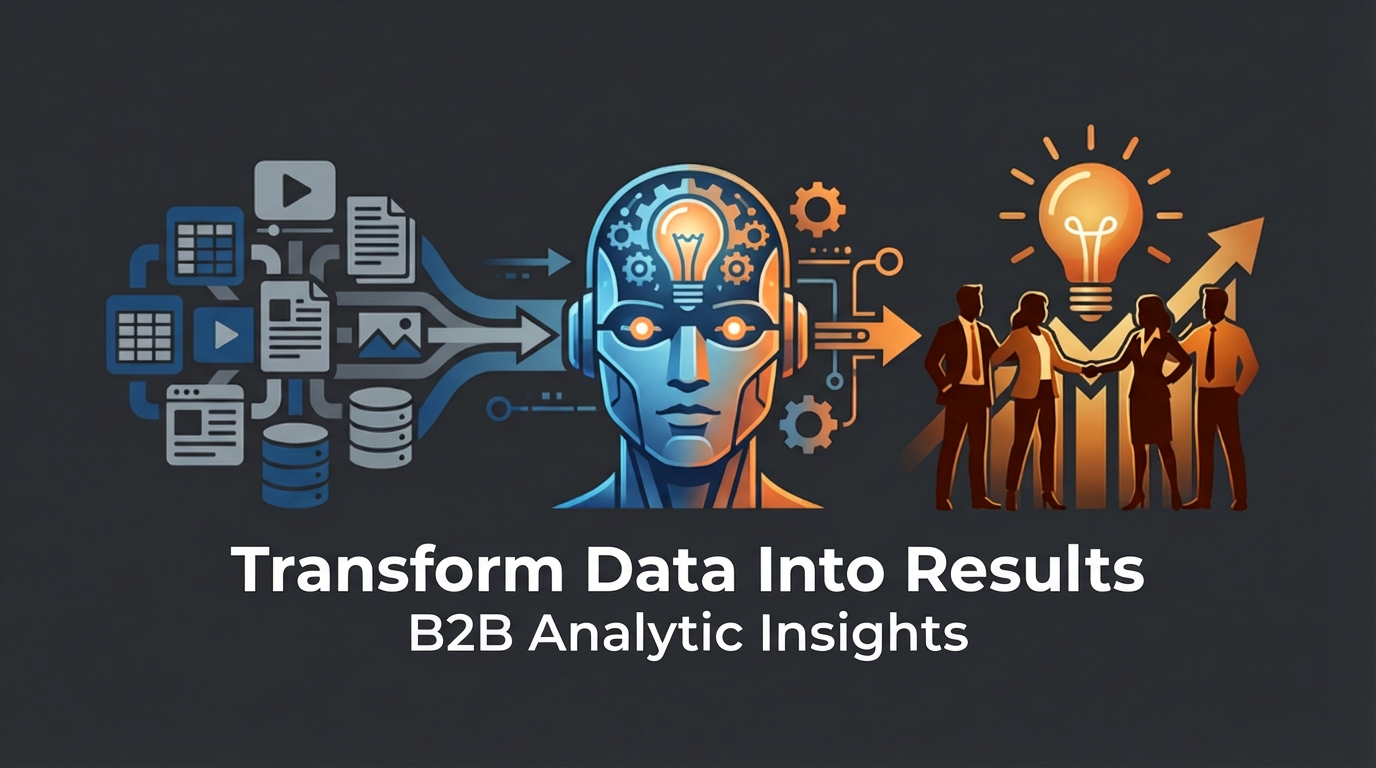

The bedrock of enterprise operations, from credit risk assessments to supply chain optimization, has long been structured data and the SQL queries that unlock its insights. For decades, our analytics teams, the silent architects of data-driven decision-making, have wielded SQL with surgical precision. But a seismic shift is underway. The language of analytics is evolving, moving beyond the deterministic syntax of SQL to embrace the probabilistic yet profoundly powerful realm of prompts. This isn’t merely a technological upgrade; it’s an analytics transformation that demands a strategic re-evaluation of how we extract value from our data assets, especially within complex B2B environments.
The Genesis of a New Era: SQL’s Enduring Legacy Meets AI’s Promise
SQL has been the lingua franca for data professionals since its inception. It’s robust, well-understood, and provides granular control. We’ve built entire empires of business intelligence and operational reporting on its foundations. But even the most sophisticated SQL developer grapples with the ever-increasing velocity, variety, and volume of data, not to mention the escalating demand for faster, more nuanced insights. This is where AI, and specifically large language models (LLMs), enters the arena, not as a replacement for SQL, but as a formidable accelerator and augmentor.
Bridging the Gap: From Declarative Queries to Conversational Interfaces
Imagine a credit risk analyst needing to quickly understand the contributing factors to recent default spikes within a specific industry segment. Traditionally, this would involve a complex series of SQL joins, aggregations, and possibly a call to a data scientist for a predictive model. Now, with generative AI woven into our analytical fabric, that same analyst might simply “prompt” the system: “Show me the top five factors contributing to loan defaults in the manufacturing sector for Q3 2025, broken down by company size.” The underlying intelligence then translates this natural language request into actionable insights, potentially even generating the SQL required to retrieve the data or directly executing a pre-trained model.
The ROI Imperative: Accelerating Time-to-Insight
For C-suite executives, the primary driver for embracing this evolution is clear: Return on Investment. We’re talking about dramatically reducing time-to-insight. Manual data wrangling, complex query construction, and iterative model development are resource-intensive. When an analyst can go from a business question to a data-backed answer in minutes rather than days or weeks, the ripple effect on strategic decision-making, operational efficiency, and competitive advantage is immense. This isn’t just about saving labor; it’s about making better, faster decisions that impact the bottom line.
In the rapidly evolving landscape of data analytics, understanding the transition from traditional SQL queries to more intuitive prompt-based systems is crucial for professionals in the field. A related article that delves deeper into this transformation is “The Future of Data Interaction: Embracing Natural Language Processing,” which explores how natural language interfaces are reshaping the way analysts engage with data. For more insights, you can read the article here: The Future of Data Interaction: Embracing Natural Language Processing.
Redefining the Analyst’s Toolkit: AI-Powered Augmentation
The traditional analytics toolkit, centered around SQL IDEs and BI platforms, is rapidly expanding to incorporate AI. This isn’t about replacing the human in the loop, but empowering them with unprecedented capabilities.
SQL Prompt’s AI Leap: Intelligent Assistance at the Keyboard
Consider Redgate SQL Prompt. Historically, it’s been invaluable for code completion and formatting. But in September 2025, it took a significant step forward by integrating AI-powered features. This includes “text-to-SQL,” where natural language commands are converted into executable SQL queries. Imagine an analyst needing to “find all customers with overdue invoices greater than 90 days and a credit score below 600.” Instead of meticulously crafting the JOINs and WHERE clauses, they can simply type that request. SQL Prompt then suggests the SQL, dramatically accelerating development.
Beyond Basic Completion: Advanced AI Capabilities
The enhancements don’t stop there. SQL Prompt also introduced “query explanations,” helping junior analysts understand complex legacy queries, and “index analysis” to optimize performance. For seasoned professionals, “intelligent suggestions” within SSMS provide recommendations for query improvements or alternative approaches, often unearthing insights that might otherwise be missed. The January 2026 update further solidified this, adding “Microsoft Fabric support” and a “preview AI code completion” feature for multi-line code generation, pushing the boundaries of what an IDE can intelligently suggest. This means less boilerplate coding and more focus on the strategic intent of the query.
Bringing AI Directly to the Data: The Database as an Intelligent Agent
The most profound shift is the integration of AI directly into the database and data warehousing environment. This moves beyond merely using AI to generate SQL; it’s about making AI an intrinsic part of data processing.
BigQuery’s Embedded AI: In-Database Generative Functions
Google Cloud’s BigQuery exemplifies this. In November 2025, BigQuery-managed AI functions like AI.IF, AI.CLASSIFY, and AI.SCORE moved into public preview. These aren’t external API calls; they are native SQL functions that bring generative AI directly into your data pipelines. An analyst performing a credit risk assessment can now use AI.SCORE within a SQL query to dynamically assess the likelihood of default based on a pre-trained model, or AI.CLASSIFY to categorize unstructured customer feedback within a dataset – all without leaving the SQL environment. This significantly reduces the friction and complexity of integrating AI into analytical workflows.
MotherDuck’s Prompt Function: LLMs at Your Fingertips
Similarly, MotherDuck announced its prompt() function in preview. This groundbreaking feature allows users to “generate, summarize, and extract structured data with LLMs directly from SQL.” Think about analyzing semi-structured data like customer support tickets or supplier contracts. Instead of writing complex regex or custom scripts, an analyst can use prompt() within a SQL query to extract specific entities (e.g., “extract supplier name and contract expiration date”) or summarize large text blocks, and have those results immediately available as structured data for further analysis. This capability unlocks massive new opportunities for deriving value from previously intractable data sources.
The Challenge of Reliability and Performance: Guardrails for Prompt Engineering
While the power of AI-driven analytics is undeniable, it’s not without its challenges. The probabilistic nature of LLMs necessitates a robust framework to ensure reliability, accuracy, and performance, especially in high-stakes B2B contexts like financial analysis or enterprise operations.
Schema-Aware Prompts: The Foundation of Accurate AI-Driven SQL
Recent industry guidance across leading analytics teams emphasizes a practical pattern for reliable prompt-driven analytics. A core tenet is the use of “schema-aware prompts.” This means providing the LLM with explicit information about the underlying data schema, including table names, column names, data types, and relationships. Without this context, an LLM might generate syntactically correct but semantically incorrect SQL. For example, if two tables have a column named “ID,” the LLM needs to know which “ID” refers to a customer and which to an order to avoid ambiguous joins.
Beyond Syntax: Business Definitions and Validation
Beyond schema awareness, “business definitions” are crucial. Explaining the business meaning of columns (e.g., “Credit_Score represents the FICO score of the applicant, ranging from 300 to 850”) helps the LLM generate more relevant and accurate queries. Furthermore, robust “validation” mechanisms are non-negotiable. Any AI-generated SQL or insights must be thoroughly validated against expected outputs and business rules. This is not a “fire and forget” system; human oversight remains paramount.
Security and Governance: Read-Only Access and Logging
In a B2B world, data security and governance are paramount. The guidance strongly advocates for “read-only access” for AI-generated queries to prevent accidental data modification. Equally important is comprehensive “logging” of all prompts and AI-generated outputs. This creates an auditable trail, essential for compliance, debugging, and understanding the model’s behavior over time. Without these guardrails, the potential for error and risk escalates dramatically.
Overcoming Performance Bottlenecks: Proxy Models for Speed and Cost
The computational cost and latency of interacting with large LLMs can be significant. Google Cloud’s new work in May 2026 on “proxy models” offers a powerful solution. These proxy models can make LLM-powered SQL queries “more than 100x faster and cheaper.” The concept is to train smaller, specialized models that can handle common analytical patterns or specific data domains, acting as efficient intermediaries to the larger, more generalized LLMs. This optimization is critical for enabling real-time, high-volume analytical workloads powered by AI.
In the evolving landscape of data analytics, the transition from SQL to prompts signifies a significant shift in how analysts interact with data. This change is not just about adopting new tools but also about embracing a more intuitive approach to data querying. For those interested in exploring the broader implications of this transformation, a related article can be found at B2B Analytic Insights, which delves into the future of analytics and the skills needed to thrive in this new environment.
Organizational Transformation: People, Processes, and Platforms
The shift from SQL to prompts isn’t just a technology update; it’s an organizational change project. Successful analytics transformation hinges on how we adapt our people, processes, and platforms.
Upskilling the Analytics Workforce: From Coders to Prompt Engineers
Our analytics leaders must recognize that the skill set required is evolving. While SQL proficiency remains foundational, analysts now need to become adept “prompt engineers.” This involves understanding how to phrase questions clearly, provide context effectively, interpret AI outputs critically, and iterate on prompts to refine results. Training programs should focus on these new competencies, enabling our teams to harness the full power of these new tools. It’s about augmenting human intelligence, not replacing it.
Evolving Data Governance and MLOps Practices
The introduction of AI into data pipelines necessitates an evolution of data governance. We need clear policies for how AI models are developed, deployed, monitored, and maintained within our analytical ecosystems. MLOps (Machine Learning Operations) best practices, including version control for prompts and models, automated testing, and continuous monitoring of AI-generated insights, become as critical as traditional DataOps. For credit risk, for example, the explainability and auditability of AI-driven risk scores are not just technical requirements, but regulatory mandates.
Selecting the Right Platforms: Integration and Scalability
Choosing the right platforms that seamlessly integrate AI capabilities with existing data infrastructure is crucial. Solutions that embed AI directly into SQL engines (like BigQuery and MotherDuck) offer significant advantages by reducing data movement and simplifying architecture. Scalability, security, and robust API access will be key considerations for enterprise-grade deployments. This is not a trivial decision; it’s a strategic infrastructure investment.
Strategic Recommendations: Navigating the Future of Analytics
The era of prompt-driven analytics is here. To thrive, organizations must act decisively.
1. Invest in Prompt Engineering Expertise: Develop internal training programs to upskill your data analysts and scientists in prompt engineering. Foster a culture of experimentation and critical evaluation of AI outputs. This is where the human expertise complements the AI’s capabilities.
2. Establish Robust AI Governance Frameworks: Implement clear policies for schema-aware prompting, business definition integration, output validation, read-only access, and comprehensive logging. For B2B, particularly in regulated industries, this isn’t optional; it’s imperative for trust and compliance.
3. Strategically Adopt Integrated AI-SQL Platforms: Prioritize database and data warehousing solutions that embed AI functions directly into the SQL environment. This minimizes complexity, reduces latency, and maximizes the “time-to-insight” for your analytical teams.
4. Pilot and Prove ROI in Specific B2B Use Cases: Start with high-value, well-defined use cases. For example, in credit risk, explore AI-driven anomaly detection in transaction data. In enterprise operations, apply it to summarize supplier contract terms or classify customer service requests. Demonstrate tangible ROI to build internal momentum and secure executive buy-in.
5. Embrace a Hybrid Approach: Recognize that AI is an augmentation, not a replacement. The deep domain expertise of your analysts, combined with the power of AI, will unlock unprecedented levels of insight and drive superior business outcomes.
The journey from SQL to prompts is not a linear progression but a profound transformation. It’s about empowering our analytics professionals to ask more sophisticated questions, extract richer insights, and accelerate the pace of data-driven decision-making across the enterprise. The organizations that embrace this evolution, with a balanced view of both opportunity and challenge, will be the ones that define the future of B2B success.