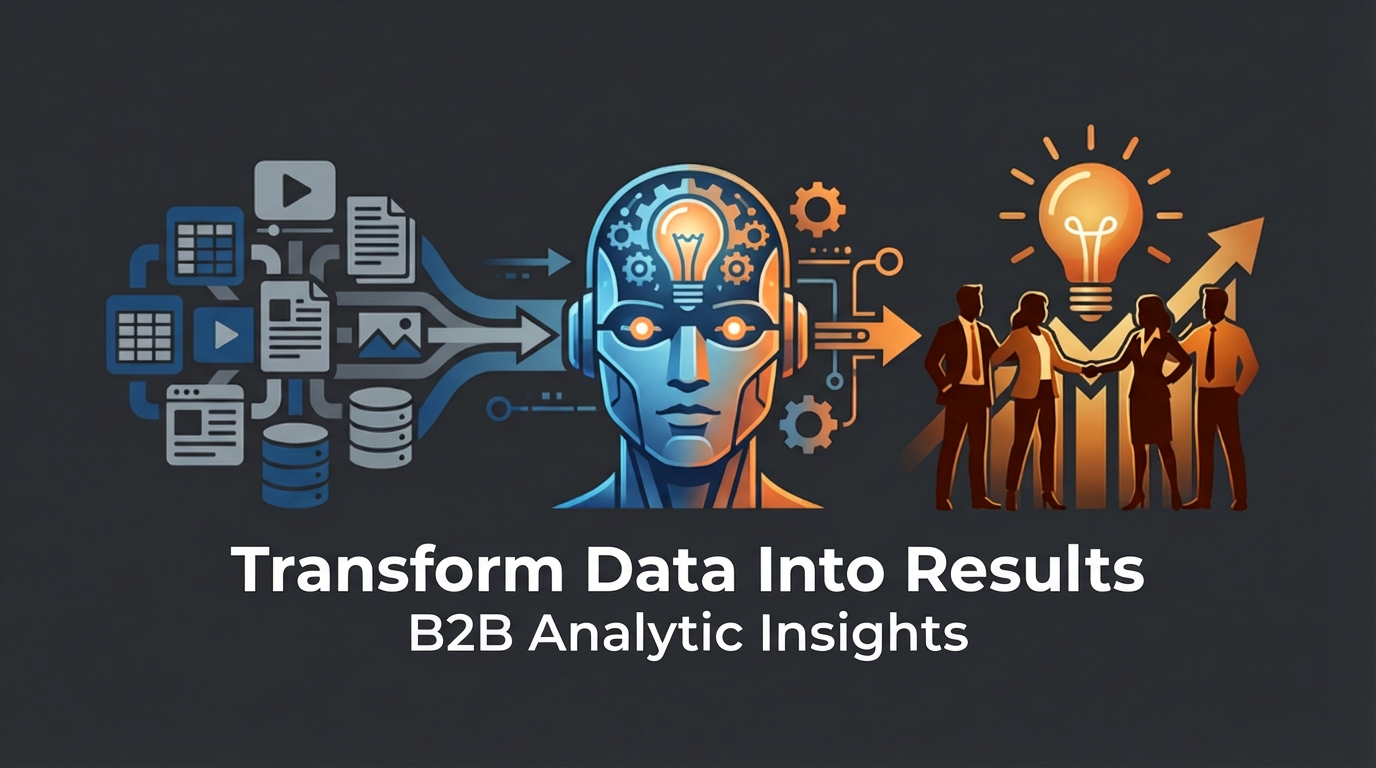

The legal sector, historically rooted in precedent and meticulous human analysis, stands at the precipice of an analytics transformation. We’re not talking about marginal gains here; we’re witnessing a paradigmatic shift in how legal professionals approach strategy, risk, and resource allocation. For decades, the sheer volume of case law, judicial decisions, and discovery materials has been an insurmountable barrier to comprehensive, data-driven decision-making. No human, no matter how brilliant, can process millions of prior decisions to discern subtle judicial patterns or anticipate opposing counsel’s next move with consistent accuracy. This is where AI steps in – not as a replacement for legal expertise, but as an indispensable accelerator and insight generator.
In the intricate world of B2B operations, particularly in areas like credit risk assessment, financial compliance, and enterprise investigations, the limitations of traditional legal research are keenly felt. Imagine a multi-billion dollar acquisition hinging on the outcome of a complex M&A dispute, or a financial institution facing a class-action lawsuit. The ability to predict potential legal outcomes with a high degree of probability, to uncover hidden risks in vast discovery sets, and to strategically position legal arguments based on empirical judicial patterns, translates directly into measurable ROI: reduced litigation costs, faster resolution times, and better-informed business decisions that safeguard reputation and capital. This isn’t just about efficiency; it’s about competitive advantage and systemic risk management.
Uncovering Hidden Judicial and Motion Patterns with AI
The bedrock of legal strategy rests on understanding the adjudicators. Traditionally, this insight was gained through years of experience, anecdotal evidence, and painstaking manual review of case outcomes. However, the scale and complexity of modern litigation render this approach woefully inadequate. AI, specifically machine learning algorithms, are fundamentally altering this landscape by identifying patterns that are simply invisible to the human eye.
The Power of Predictive Judicial Analytics
AI tools can analyze millions of prior decisions, not just at a national or state level, but granularly by specific judge and jurisdiction. This analysis goes far beyond keyword searches. It delves into the nuances of judicial language, the timing of decisions, the prevalence of certain citations, and even the outcomes of specific motion types within a judge’s courtroom. For instance, these systems can detect judge-specific ruling tendencies, identifying whether a particular judge is more likely to grant motions to dismiss under certain circumstances, or if they lean towards particular types of remedies in contract disputes. This insight is gold. It empowers legal teams to tailor their arguments, select favorable venues where possible, and even strategically time their filings based on a data-backed understanding of the presiding judge’s predilections.
Deconstructing Jurisdictional and Opposing Counsel Dynamics
Beyond individual judges, AI also illuminates broader jurisdictional dynamics. Are certain federal districts more receptive to particular legal theories? Do certain appellate courts consistently overturn lower court decisions in specific areas of law? By aggregating data from vast swathes of cases, AI identifies these macroscopic trends. Furthermore, AI can dissect the strategies of opposing counsel. By analyzing their past case filings, motion success rates, and even the language used in their briefs, AI can identify recurring patterns and preferred tactics. This predictive intelligence allows legal teams to anticipate moves, proactively counter arguments, and develop more robust defense or offense strategies. It’s like having access to a data-driven scouting report on every player on the field – a significant strategic advantage in high-stakes litigation.
In the realm of legal analytics, the article titled “Harnessing AI for Predictive Legal Outcomes” provides valuable insights into how artificial intelligence is transforming the legal landscape. This piece complements the discussion on how AI uncovers patterns in case law and discovery by exploring predictive modeling techniques that help legal professionals anticipate case outcomes based on historical data. For more information, you can read the article here: Harnessing AI for Predictive Legal Outcomes.
Predictive Legal Analytics: Forecasting Outcomes with Data
Forecasting legal outcomes used to be an art, a skill honed over decades of practice, riddled with educated guesses and instinct. Now, with the advent of predictive legal analytics, it’s becoming an increasingly precise science. AI models, trained on comprehensive datasets of court decisions, motions, and verdicts, are generating probability scores that offer unprecedented clarity on case strength and potential outcomes.
Quantifying Case Strength and Settlement Viability
Imagine being able to present your C-suite with a probability score for the dismissal of a compliance-related lawsuit, or the likelihood of a favorable settlement in a significant intellectual property dispute. This isn’t speculative; it’s data-driven. AI models analyze hundreds of variables – the nature of the claim, the strength of evidence, precedents, judicial tendencies, and even the historical success rates of involved legal teams – to generate these probability scores. This allows in-house counsel, and their external partners, to objectively assess the strengths and weaknesses of a case. It transforms the often subjective “gut feeling” into a quantifiable metric. This shift is critical for resource allocation, enabling businesses to prioritize legal spend on cases with higher probabilities of success and to consider settlement options strategically, rather than reactively. This significantly impacts the time-to-insight for critical business decisions.
Beyond Dismissal: Predicting Verdicts and Damage Awards
The predictive power extends beyond simple dismissal or settlement. Advanced AI models can also provide probability scores for trial outcomes, including the likelihood of conviction or acquittal in criminal cases (though B2B rarely sees criminal cases directly, this demonstrates the model’s capability), and more importantly for businesses, the potential range of damages awarded in civil litigation. For a company facing a product liability claim, knowing the likely damage award range, predicated on historical data and similar cases, can completely alter their negotiation strategy and financial provisioning. This proactive financial analysis is a cornerstone of responsible enterprise operations and risk management. Pre/Dicta’s claim of 85% accuracy in predicting motions to dismiss across all 94 U.S. federal district courts, leveraging judicial attributes and docket patterns, is a testament to the practical efficacy of these tools. Such precision transforms legal risk from a nebulous unknown into a manageable, quantifiable factor.
Generative AI: Unlocking Insights in Unstructured Discovery Data
Discovery is often the most resource-intensive and time-consuming phase of litigation. Traditionally, it’s a manual slog through mountains of documents, emails, and increasingly, digital communications. The sheer volume of unstructured data – voicemails, videos, instant messages, and even social media posts – has rendered traditional keyword-based e-discovery tools inadequate for truly uncovering critical insights. This is where generative AI is a game-changer.
Beyond Keywords: Semantic Understanding and Contextual Analysis
Unlike older analytics tools that struggled with anything beyond structured data fields, generative AI excels at processing and understanding unstructured information. Imagine a legal team trying to identify a pattern of discriminatory language across thousands of internal emails and chat logs. A traditional tool might flag keywords, but generative AI can understand the context and intent behind the language, identifying subtle patterns of bias or non-compliance that a human would take weeks to manually sift through. It can read, summarize, and even synthesize information from disparate data sources, revealing hidden risks, opportunities, and case-specific insights that would otherwise remain buried deep within the data. This capability is paramount in complex B2B litigation involving intellectual property theft, antitrust violations, or contractual disputes, where critical evidence is often embedded in informal communications.
Identifying Risks and Opportunities in Vast Datasets
Consider a scenario in financial fraud investigation. Traditional methods would struggle to cross-reference thousands of voicemails with email chains and transaction logs. Generative AI can weave these disparate threads together, identifying anomalies, suspicious communication patterns, and potential conspiratorial networks that would be impossible for human analysts to spot. This accelerated time-to-insight is not just about cost savings; it’s about preventing potentially ruinous financial penalties and reputational damage. From identifying previously unrecognized contractual loopholes in legacy agreements to flagging potential compliance breaches in real-time communications, generative AI transforms discovery from a reactive burden into a proactive intelligence gathering operation.
The Imperative of Rigorous AI Benchmarking and Certification
While the potential of legal AI is transformative, we must approach its implementation with a clear-eyed understanding of its current limitations. The current buzz around AI, particularly generative AI, often overshadows its very real, and in a legal context, potentially devastating, shortcomings.
Addressing the Hallucination Risk
The elephant in the room is the “hallucination” problem. Bespoke legal AI tools, while generally more accurate than general-purpose LLMs for legal applications, still produce incorrect information between 17% and 34% of the time. This is an unacceptable error rate in a profession where accuracy is paramount, and errors can lead to malpractice, sanctions, or the loss of critical cases. This isn’t just about minor inaccuracies; it’s about the AI fabricating non-existent precedents, misinterpreting statutes, or hallucinating facts. The implications for B2B operations, where legal precision underpins everything from contract enforcement to regulatory compliance, are profound. A faulty AI-generated legal opinion could lead to billions in lost revenue or regulatory fines. Therefore, robust benchmarking and transparent, public evaluations, not just internal vendor claims, are non-negotiable.
Federal Judges Mandate AI Certification
The legal community, particularly the judiciary, is acutely aware of these risks. Several U.S. federal judges have already issued orders mandating lawyers to certify the use and accuracy of AI in their briefs. This is a significant development, placing the onus directly on legal practitioners to ensure the reliability of AI-generated content. For analytics leaders implementing these technologies within legal departments, this means that validating AI outputs is no longer an optional best practice but a regulatory requirement. It underscores the critical need for hybrid models where human expertise acts as the ultimate guarantor of truth and accuracy, especially in high-stakes legal submissions. Skipping this human oversight is not just risky; it’s negligent.
Legal analytics is revolutionizing the way legal professionals approach case law and discovery by leveraging AI to uncover hidden patterns and insights. For those interested in exploring this topic further, a related article discusses the transformative impact of technology on the legal field and how it enhances decision-making processes. You can read more about it in this insightful piece on legal innovation. If you want to reach out for more information, feel free to visit this link.
Navigating the Human-AI Frontier in Legal Transformation
Analytics transformation in the legal sector, much like in finance or enterprise operations, is not merely about deploying new technology. It’s about fundamentally reshaping workflows, skill sets, and organizational culture. The journey is complex, requiring a delicate balance between embracing technological innovation and preserving the intrinsic value of human judgment and ethical oversight.
Bridging the Skill Gap: From Legal Theory to Data Science
Successfully integrating legal AI requires a workforce that can bridge the traditional divide between legal theory and data science. Attorneys and paralegals need to understand how these models work, their limitations, and how to effectively prompt and interpret their outputs. Simultaneously, data scientists and AI engineers working within legal tech must grasp the nuances of legal reasoning, the importance of precedent, and the ethical considerations inherent in legal practice. This necessitates significant investment in upskilling and cross-functional training. We cannot simply drop a sophisticated AI tool into a legal department and expect magic; careful change management and skill development are paramount. This is a B2B challenge: aligning technology with existing operational processes and legal frameworks.
The Strategic Imperative: ROI and Ethical Considerations
For C-suite executives, the ROI of legal analytics transformation is clear: reduced litigation costs, improved compliance, faster resolution of disputes, and better-informed strategic decisions. These are measurable outcomes that directly impact the bottom line. However, this transformation must be guided by a robust ethical framework. The certification requirements from federal judges highlight the critical importance of maintaining accountability and ensuring justice is served accurately. It means investing in “explainable AI” where possible, understanding data provenance, and establishing clear guidelines for human review and ultimate responsibility. The goal isn’t to fully automate legal reasoning, but to augment it with powerful analytical capabilities, thereby achieving a future where legal practice is more efficient, more predictable, and ultimately, more just.
In conclusion, legal analytics, powered by AI, is no longer a futuristic concept; it’s a present-day reality rapidly reshaping the legal landscape. From uncovering hidden judicial patterns to accurately predicting case outcomes and revolutionizing discovery, the capabilities are undeniable. However, acknowledging the challenges, particularly around accuracy and the imperative for human oversight, is crucial. The path forward involves a strategic, phased implementation, a commitment to rigorous human-AI collaboration, and a dedication to continuous learning and adaptation. This is an analytics transformation that promises not just efficiency, but a profound elevation of strategic legal insight across all facets of B2B operations.