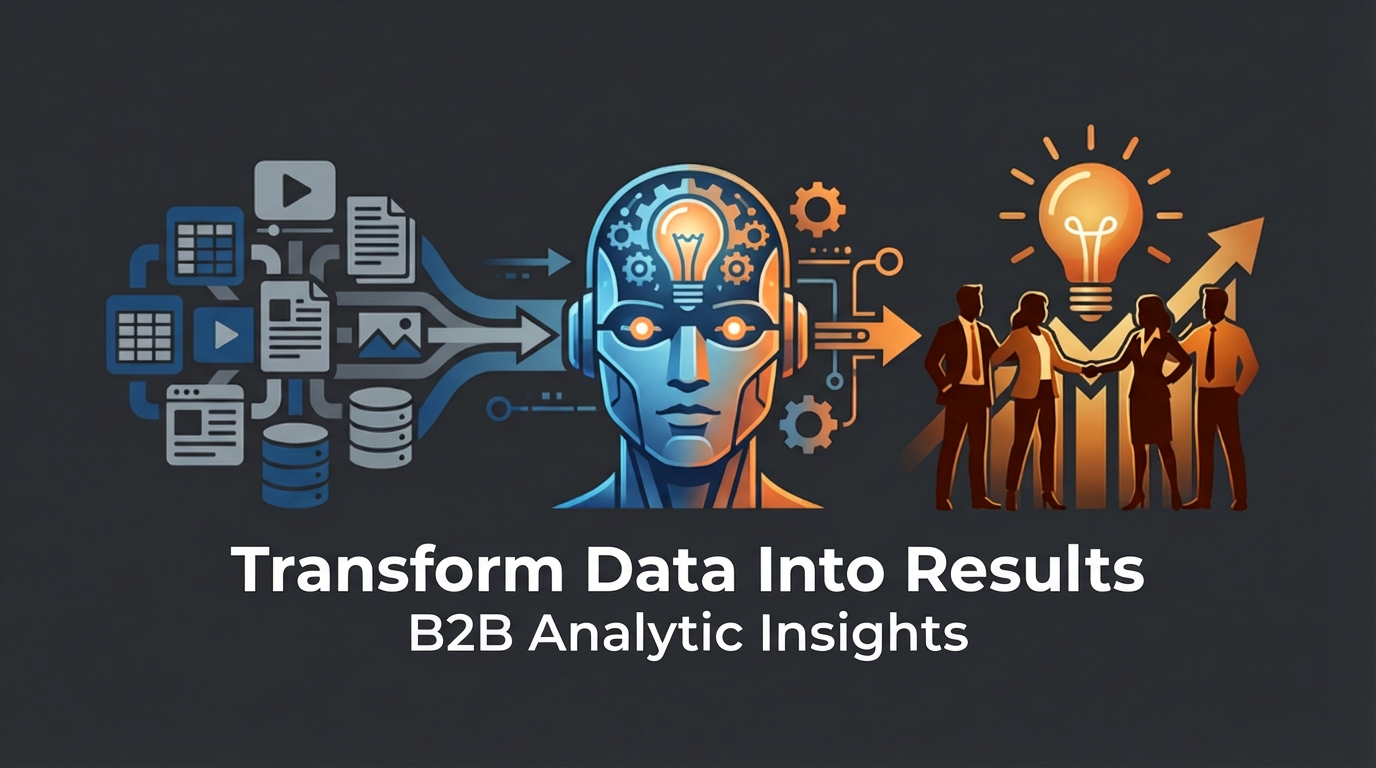

The retail landscape, like all competitive battlegrounds, demands foresight and surgical precision. For decades, retailers grappled with a lagging view of their customers. We meticulously analyzed what had happened, painstakingly sifting through transaction records to understand past purchases. This descriptive analytics, while foundational, was like driving a car solely by looking in the rearview mirror. Today, the conversation has fundamentally shifted. We’re no longer just talking about market basket analysis; we’re talking about predicting consumer motivation before it translates into a sales trend, moving from historical snapshots to a real-time, predictive panorama. This isn’t just an evolution; it’s an analytics transformation, fundamentally altering how we engage with customers, manage operations, and drive profitability in an increasingly competitive B2B ecosystem. And for the C-suite, the numbers are compelling: UK retail giants are seeing an average ROI of 340% on their £2.1 billion annual investment in data analytics, with profit margins up to 15% higher. This isn’t optional; it’s existential.
The core problem for retailers has always been anticipating demand and understanding consumer behavior quickly enough to act. Traditional analytics provided answers to “what happened?” and “how many?” but rarely “why?” or “what’s next?”. This is where the retail analytics revolution truly takes hold. We are witnessing a profound shift from quarterly descriptive reports to continuous, real-time feeds of consumer behavior.
Decoding Customer Motivation, Not Just Purchases
Forget simply tracking what sold last quarter. Today’s retailers are leveraging sophisticated models to predict intention before it materializes as a purchase. This means understanding the underlying motivations, the specific occasion driving a purchase, or even granular flavor preferences.
- Behavioral Signals for Proactive Intervention: Instead of reacting to declining sales, AI-driven churn models are scoring the likelihood of a customer stopping purchases based on subtle signals – a widening gap between orders, a noticeable drop in average basket size, or a shift in product categories. This allows retention teams to intervene weeks, not days, before a customer is lost, significantly improving customer lifetime value.
- Contextualizing Consumption: Beyond individual product preferences, we’re now mapping consumption patterns based on daypart or life events. This isn’t just about suggesting a complementary item; it’s about understanding that a morning commute purchase differs dramatically from a weekend family meal, allowing for hyper-relevant recommendations and promotions.
In the rapidly evolving landscape of retail analytics, the article “Retail Analytics Revolution: From Basket Analysis to Behavioral Prediction” provides valuable insights into how data-driven strategies are transforming the industry. For those interested in exploring further, a related article on the importance of predictive analytics in enhancing customer experiences can be found at B2B Analytic Insights. This resource delves into the ways businesses can leverage data to anticipate consumer behavior and optimize their marketing efforts.
The AI Engine: Generative Insights and Causal Understanding
The leap from correlational analysis to understanding causal inference is perhaps the most significant advancement, powered by the convergence of Generative AI and probabilistic modeling. We’re moving beyond “these things happen together” to “this caused that.”
Unraveling Complex Relationships with Generative AI and PGMs
The integration of Generative AI, exemplified by platforms like Google’s Gemini or Walmart’s AI search, with Probabilistic Graphical Models (PGMs) and Causal Inference, is disentangling complex causal relationships that were once opaque.
- Beyond Promotion Performance Metrics: Historically, we’d measure the uplift from a promotion. Now, we can understand not just if a promotion worked, but why it worked for specific customer segments, and critically, what was the true incremental impact versus cannibalization or baseline drift. This enables data-backed arguments for optimal promotion mechanics and timing.
- Optimizing Product Placement and Assortment: PGMs allow us to model the interplay between product adjacencies, visual merchandising, and purchase decisions. This moves beyond intuition, providing clear insights into how rearranging a shelf, or introducing a new product line, will impact sales across the entire category, enabling more strategic enterprise operations.
Precision Forecasting: Orchestrating the Supply Chain in Real-Time

Inventory is capital, and capital tied up in slow-moving stock is a drag on profitability. Conversely, stock-outs lead to lost sales and dissatisfied customers. The ability to forecast demand with unprecedented precision is no longer a luxury; it’s a competitive imperative.
Advanced Models for Hyper-Accurate Demand Prediction
The emergence of new foundation time series models like Chronos-2 and TimesFM-2.5, alongside powerful gradient boosting methods (LightGBM, XGBoost), has propelled demand forecasting to account for 30% of the predictive analytics market.
- SKU-Level Granularity: We are moving away from aggregate forecasting to precise inventory and pricing decisions at the individual SKU level, considering an immense array of internal and external variables. This dramatically reduces waste and optimizes pricing strategies for maximum margin.
- Dynamic Pricing at Scale: Beyond simple markdown rules, these advanced models enable dynamic pricing strategies that react to real-time demand, competitor pricing, and even localized events, maximizing revenue per unit sold. This impacts not only top-line growth but also significantly enhances profitability.
From Simple Bundles to Strategic Cross-Merchandising Arguments

Market Basket Analysis, once a straightforward way to identify product co-occurrence for simple bundling, has matured into a sophisticated tool for strategic cross-merchandising and occasion tracking. It’s no longer about identifying “customers who bought X also bought Y” but understanding the impetus behind those combined purchases.
Elevating Basket Analysis to Cross-Merchandising Intelligence
The evolution here is critical for driving incremental purchases and enhancing the in-store and online customer experience.
- Data-Backed Cross-Merchandising: Retailers are now using detailed analytics to provide data-backed arguments for optimized cross-merchandising placements within stores or personalized recommendations online. This goes beyond logical pairings (e.g., milk and cereal) to uncover less obvious, yet highly effective, combinations driven by occasion or motivation (e.g., specific snacks purchased for a sporting event).
- Predictive Bundling in Conversational AI: The industry is moving rapidly towards “conversational upsells” via AI chat flows. Here, predictive bundling isn’t an academic concept; it’s a mainstream profit engine. AI proactively suggests complementary items based on real-time conversational context and predicted needs, turning customer interactions into direct revenue opportunities. This is active revenue generation, not just passive reporting.
In the rapidly evolving landscape of retail analytics, understanding consumer behavior has become paramount for businesses seeking a competitive edge. A related article that delves into this transformation is available at The Power of Analytics: Transforming Data into Meaningful Actions, which explores how data-driven insights can lead to more effective decision-making and enhanced customer experiences. By leveraging advanced analytics, retailers can not only refine their basket analysis but also predict future buying behaviors, ultimately driving sales and fostering customer loyalty.
Achieving Massive ROI and Driving Organizational Change
| Metrics | 2018 | 2019 | 2020 |
|---|---|---|---|
| Customer Conversion Rate | 25% | 27% | 30% |
| Average Basket Size | 3 items | 3.5 items | 4 items |
| Customer Retention Rate | 70% | 75% | 80% |
The investment in retail analytics is substantial, but the returns are undeniable. Digital-native strategies, underpinned by robust analytics, are driving considerable revenue growth and significant profit margin improvements.
Quantifiable Returns on Analytics Investment
The commitment required isn’t merely technological; it demands an organizational shift towards a data-driven culture.
- Compounding Growth from Digital-Native Strategies: Retail leaders are experiencing revenue growth of 25% by strategically embedding analytics into their digital operations, from personalized marketing campaigns to optimized logistics. This isn’t just about having data; it’s about having the capability to act on it decisively and at scale.
- The Critical Role of Leadership and Transformation Frameworks: Achieving these returns requires more than just deploying new tools. It necessitates an analytics transformation, driven from the top down, with clear strategic goals, appropriate investment in human expertise, and a willingness to embrace organizational change. We must bridge the technical prowess of data scientists with the strategic vision of business leaders, ensuring that every insight translates into actionable commercial advantage. This means robust governance, clear data ownership, and a continuous learning environment.
In the ever-evolving landscape of retail analytics, the shift from traditional basket analysis to advanced behavioral prediction is transforming how businesses understand consumer habits. A related article that delves deeper into the implications of these advancements can be found on the B2B Analytic Insights website, where they explore the broader impact of data-driven decision-making in retail. For more insights, you can read about it here. This comprehensive approach not only enhances customer experiences but also drives strategic growth for retailers navigating the complexities of modern commerce.
Strategic Recommendations for the Data-Driven Retailer
To truly capitalize on this analytics revolution, retailers must adopt a multi-faceted approach that balances technology, human capital, and strategic vision.
Firstly, invest aggressively in granular, real-time data capture and integration. The foundation of any advanced analytics capability is clean, comprehensive, and continuously updated data. This means integrating point-of-sale, e-commerce, loyalty programs, and external datasets (weather, local events, social sentiment) into a unified platform. Without this, even the most sophisticated AI models are starved of the fuel they need. Your time-to-insight is directly proportional to your data pipeline efficiency.
Secondly, prioritize building an AI-first culture and core competencies. This is not about hiring a few data scientists; it’s about embedding analytical thinking throughout the organization. Invest in training business leaders to interpret and challenge models, and empower practitioners with the best tools and development opportunities. Focus on capabilities like causal inference and probabilistic modeling to move beyond correlation. The blend of technology and human expertise is critical for translating raw data into strategic advantage.
Thirdly, operationalize predictive insights into automated workflows. The true power of real-time behavioral signals and precision forecasting lies in their ability to trigger immediate, automated actions. This could be dynamic pricing adjustments, personalized promotion delivery via AI chat flows, or real-time inventory rebalancing. Shift from manually generating reports to automatically executing strategies based on predictive intelligence. This significantly reduces time-to-insight and improves operational agility. Don’t just understand; act.
Finally, continuously measure and iterate on the ROI of your analytics investments. Leverage robust A/B testing and incrementality measurement frameworks to quantify the direct impact of your analytics initiatives on sales, profit margins, and customer lifetime value. The retail landscape is constantly evolving, and your analytics strategy must be agile enough to adapt. Engage with your C-suite on these metrics, demonstrating tangible business impact that goes beyond theoretical concepts, proving that analytics isn’t a cost center, but a direct profit driver. This is about disciplined execution and a relentless focus on bottom-line impact. The future of retail belongs to those who don’t just watch the market, but actively shape it through intelligent, data-driven decisions.