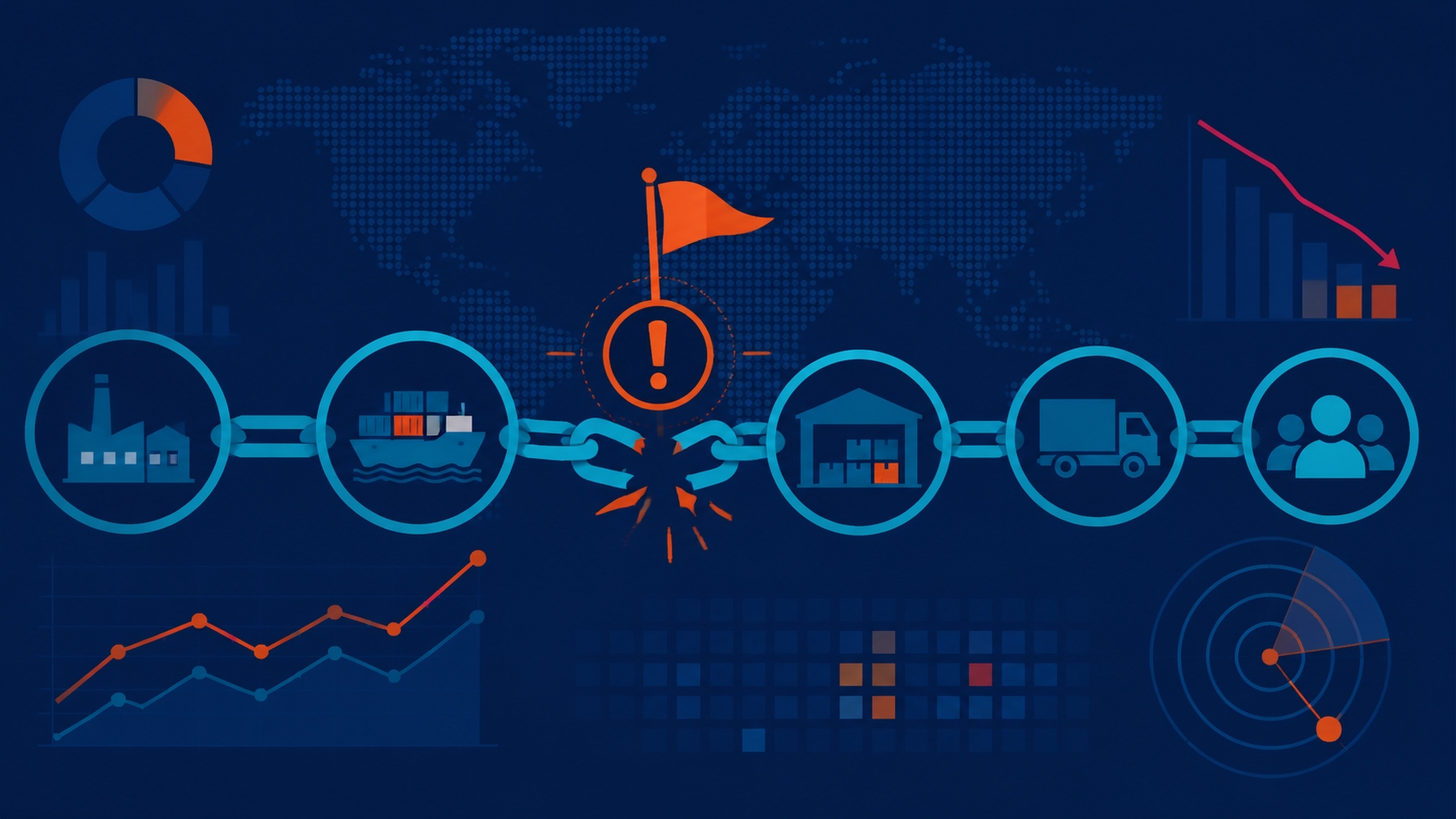
The plant floor hums with data. Sensors predict when a machine will fail, and maintenance teams act before the line stops. That is a real win, and it protects margin. But the failure that hurts most is often not on the plant floor at all. It is two tiers up the supplier network, where a financially fragile supplier is quietly approaching the point where it cannot deliver.
Operational risk is financial risk
A machine that fails unexpectedly costs more than the repair. It costs downtime, expediting fees, overtime, and sometimes a customer. Those are financial events, and they are exactly what predictive maintenance is designed to prevent. The same logic applies one level up. A supplier that fails unexpectedly costs the same things, plus a scramble to re-source that can take months.
The visible win and the hidden exposure
Predictive maintenance is the visible, celebrated use of analytics in manufacturing. It is easy to justify because the return shows up fast. Supplier financial health is the hidden exposure, because it is harder to see and easier to defer. Yet a single point of failure in the supplier base can halt production more completely than any single machine.
This is procurement risk, and it belongs in the financial conversation. Your suppliers are a credit risk. Their financial health is your operational continuity.
What external insights add
A manufacturer knows its own production data. It rarely knows the financial condition of its tier two suppliers, the ones it does not buy from directly but depends on completely. External insights, supplier financial statements, payment behavior, and entity linkage, reveal the health of the network behind the network. That is where invisibility hides, and it is where external data earns its place.
The race with the machine
AI can monitor the supplier network continuously, flag the entity whose payment behavior is deteriorating, and map the concentration risk that no single buyer can see alone. It can carry the baseline, the monitoring and the flagging, across thousands of entities. What it cannot do is make the procurement decision or own the relationship. Finance and procurement weigh the signal and decide. The machine watches the network. The people decide what to do about it.
What to do
Connect the operational data you already collect to the financial reality of your supplier base. Watch the tier two suppliers, not just the tier one. And treat supplier financial health as a line item in your risk plan, because the plant floor is only as reliable as the network that feeds it.
Internal Knowledge + External Insights = Competitive Intelligence. That is your Decision Intelligence Framework.