
Most AI conversations start with the wrong question. Not a bad question, just the wrong one.
The question on the table is usually price. Tokens. Seats. Which model is cheaper this quarter. That frame is comfortable because it is measurable, and it is dangerous because it decides nothing. A leader can win the price negotiation and still capture none of the value.
I want to reframe it. The conversation should not be about what AI costs. It should be about what it returns, who owns the return, and what has to change in your operation for the return to exist. That is an investment conversation, and it belongs to the leader, not the vendor.
A word on where I sit, because it matters for how you read this. My day job is to build and price these capabilities. So I know the vendor’s side of the table well. This piece is written from the leader’s chair, not mine. The market deserves to understand what it actually needs, why its resistance is rational, and how to tell a real partner from a polished pitch. That is the whole point.
The race we keep misreading
In late 2019, every planning room had the same conversation. More than 120 months without a recession. Ten years of straight growth. The only real debate was which small thing would finally end it. Then the surprise arrived, and it was not in anyone’s model.
Today the planning rooms have a new script, and the new script is a race with the machine. The machine gets faster, cheaper, and more capable every quarter, and leaders scramble to keep up. It is a compelling story. It is also a distraction.
The race was never with the machine. The machine will improve without your permission, forever. The race is with the baseline. The baseline is how the work gets done today. The queue that clears on Thursday. The credit decision that takes nine days. The supplier review that lives in a spreadsheet and one person’s memory. The status quo has tenure, habit, and no line item to defend it. In most organizations, the baseline is winning.
History is patient with this pattern. Mainframes were argued about on price, and the value arrived when transactions moved through them. ERP was argued about on price, and the value arrived when planning and finance finally shared one record. The internet was argued about on bandwidth, and the value arrived when distribution changed shape.
Each time, the market argued about the cost of the tool while the value came from the redesign of the decision. Each time, the organizations that captured the value were not the ones with the cheapest license. They were the ones that changed how the work moved.
The market debates the cost of the tool. The durable value comes from the redesign of the work.
The investment question, not the price question
Here is the shift I would ask every executive to make before the next budget cycle.
Stop asking what AI costs. Start asking what it returns, and whether your organization is positioned to capture that return. Those are different conversations, and the second one is the one that decides outcomes.
An investment frame asks four things that a price frame never does.
- What is the return, and on what measure? Not a feeling about productivity. A named metric. Cycle time. Error rate. Cash conversion. Recovery rate. If the return cannot be named, it cannot be governed, and it cannot be defended.
- Who owns the return? Every investment needs an owner. If no executive owns the outcome, the program becomes a cost center with a subscription.
- What has to change for the return to exist? This is the part most business cases skip. The return usually depends on a process change, a policy change, or a governance change. If none of those change, the tool adds a layer instead of removing friction.
- What is the payback, and when? Not a promise. A range, with the assumptions written down, so the investment can be reviewed like any other.
That frame also changes who is in the room. A price conversation belongs to procurement. An investment conversation belongs to the leaders who own the P&L, the risk, and the cash cycle. That is where it should have been all along.
The fear is rational
It is worth saying plainly to every leader who has hesitated. The fear of AI is not irrational. It is evidence of judgment, and it deserves respect rather than a sales pitch.
The risks are structural, not cosmetic. Models that can behave differently when they know they are being tested. Safeguards that may fail against a better attacker. Releases that move from months to days while governance still moves in quarters. Good intentions do not fix structural risk.
But unfocused fear has a price of its own. When caution becomes a reason to stop, the baseline keeps winning. The exposure you carry today does not pause because the tool is uncertain. The counterparty still deteriorates. The invoice still ages. The supplier still struggles.
The organizations that capture value will not be the ones with the fewest controls. They will be the ones whose controls are precise enough to let the work move. Govern where the decision binds. Identity. Authority. Limits. Escalation. Audit. Then let the rest of the process run. That is not caution for its own sake. That is how you go faster without losing the thread.
The novelty trap
Most AI programs are funded as experiments and never promoted to operations. The demo delights. The pilot works. Then the team asks for integration, and the answer is, not yet.
This is the novelty trap, and it is expensive in a quiet way. Novelty is measured in impressions. Value is measured in cycle time, error rate, and cash conversion. These are not the same scoreboard, and the first one is easier to feed.
The economics make the trap worse. A cheaper model can become a more expensive program, because usage scales faster than budget. Prompts multiply. Agents retry. The bill that looked small at pilot becomes the line item finance challenges at renewal.
The lesson is not to avoid AI. It is to stop funding novelty and start funding applications. Ask what process changes if this works. If the answer is a feeling, it is an experiment. If the answer is a decision, a threshold, a workflow, or a counterparty outcome, it is an application. Fund the second one.
The power of the and
Value does not come from replacing systems. It comes from connecting them.
The modern finance stack is not a single tool. It is layers that have to agree. A data layer that captures signals. A semantic layer that gives them shared meaning. An analytic layer that finds the pattern. A decision layer that turns the pattern into governed action. An execution layer that applies it, in onboarding, underwriting, monitoring, and collections.
AI is not a new layer that sits on top and replaces the others. It is the connective tissue that makes the layers work together. That is the power of the and.

There are two inputs, and they are stronger together than apart.
- Internal knowledge is what your team already knows. Payment history you have collected. Portfolio behavior you have observed. Ground truth from your own accounts. It is deep, but narrow.
- External insight is what the market can see that you cannot see alone. Entity verification. Financial condition. Scaled predictive models. Payment patterns across the economy. It is broad, but shallow.
- The and is the output when the two are combined and applied at the decision point. It is not raw data. It is the ability to see change sooner, act earlier, and price risk more accurately than a peer working from one side alone.
There is a second and that matters now. Enterprises increasingly want AI they can own, running on infrastructure they control. When inference runs inside your own environment, it scales at marginal cost and keeps your data under your governance. The strategic question is not which model is best. It is which combination of owned capability and external insight compounds inside your own operating model.
Economic transparency at scale
The deepest value in this shift is not speed. It is transparency.
For the first time, an organization can see cost, risk, and cash flow at the decision point, across the whole relationship base, in a repeatable way. Not in a quarterly report. At the moment the decision is made.
That transparency has two sources. The body of internal knowledge, which is what you have observed about your accounts, your counterparties, your suppliers, and your payment cycles. The stream of external insight, which is identity, financial condition, market level payment behavior, and scaled predictive signals. Governance is what makes the combination defensible. Without it, transparency becomes exposure.
This is why data quality is not a project. It is a precondition. Economic transparency at scale is only as good as the meaning underneath it. Shared definitions. Verified entities. Consistent thresholds. The semantic layer is the difference between a real signal and a confident guess.
Land it on the money, always. The capital layer lands on your cost of funds. The policy layer lands on your margin. The consumer layer lands on your receivables and your cash conversion. When you can see all three at the decision point, you are no longer reporting the past. You are pricing the future.
The rise of new decisions
Adoption becomes innovation when it changes what you are able to decide.
A better model does not create a new decision. A better defined decision does. When internal knowledge and external insight are combined and governed, decisions that were previously too slow or too expensive to make become routine.
- Which counterparty to extend, and by how much, decided at the limit rather than after the loss.
- Which supplier to pre pay and which to monitor, based on financial condition, not habit.
- Which invoice to finance and which to chase, priced by payment probability.
- Which customer is quietly deteriorating while the relationship still looks healthy.
- Which exception deserves a human, and which can clear at the speed of the transaction.
These are not new categories of decision. They are old decisions made earlier, more consistently, and at a scale no manual process could hold. Innovation here is not a new product. It is a new cadence.
And it compounds. Every governed decision produces an outcome. Every outcome produces data. Every data point sharpens the next decision. That loop, not any single model, is the durable asset.
The operations leader’s storyline
If you are the operations leader, the story you tell determines whether this lands or stalls. Here is the arc I would use.
- The friction. Name the specific work that is slow, manual, or inconsistent. Not “we need AI.” Instead, “credit decisions take nine days, and the last mile is where the opportunity ages.” Make the status quo the antagonist.
- The signal. Show the two inputs that were never connected. What we know about our own accounts. What the market knows about them. The gap between the two is the exposure you are carrying without seeing it.
- The decision. Put a threshold, a policy, and an owner on the signal. Governed action is what turns insight into outcome. Show what changes the moment the decision is made earlier.
- The loop. Measure the decision, not the model. Cycle time. Error rate. Cash conversion. Recovery rate. Then widen the loop, one decision lane at a time. Procurement. Receivables. Onboarding. Monitoring.
Every act lands on the same place. Cash flow, margin, and working capital. Every role is responsible for the next profitable decision. That is how the signal becomes an outcome.
What to look for in a partner
If the investment frame is right, then the partner you choose matters more than the model you license. Here is a short list I would put in front of any selection committee. It is the same list I would want held against my own work.
- A partner who defines the decision with you first. Before the demo, they should be able to name the process, the threshold, and the owner. A vendor who leads with capability before understanding your decision has skipped the only part that matters.
- A partner who shows you the return, not the tool. Ask them to model the outcome on your numbers. If they cannot connect the capability to cycle time, cash conversion, or loss avoidance, the return is hypothetical.
- A partner who brings external insight to your internal knowledge. One side alone is a partial view. The partner who can combine what you know with what the market sees is the one who changes your decisions.
- A partner who will be governed. They should expect and welcome your controls. Identity. Authority. Limits. Escalation. Audit. A partner who resists governance is selling you speed you cannot keep.
- A partner who gives you the exit. Ask what happens to your data, your definitions, and your models if you leave. Ask whether the capability runs in your environment. The right partner answers that question before you ask it.
- A partner who prices the investment, not the seat. A pricing conversation that ignores the return is a negotiation, not a partnership. The best partners want their fee tied to the outcome you both believe is real.
That list is short on purpose. It is also uncomfortable, because it turns the review around. The leader is not auditioning the vendor. The vendor is auditioning for a seat at the decision table, and the leader holds the standard.
The 90 day value capture test
Before the next budget conversation, score your organization on ten statements. Zero is not true. One is partially true. Two is fully true. The total points to a stage, and the two lines you scored zero are the gaps where the baseline is still winning.
Baseline
- We can name the single process where AI would change a decision, not a feeling.
- We know the current cycle time and error rate of that process.
Integration
- Our AI effort connects to systems of record, not a separate tool.
- We combine internal knowledge with external insight in one workflow.
Governance
- Authority, limits, and escalation are defined where the decision binds.
- We can explain, after the fact, why any automated decision was made.
Transparency
- We see cost, risk, and cash flow at the decision point, not only at reporting.
- Our entity and definition layer is verified and shared.
Decision and loop
- We measure the decision (cycle time, cash conversion), not the model.
- We have widened at least one decision lane from pilot to production.
Your stage. Zero to five is stage one, accidental. Six to eight is stage two, formalizing. Nine to ten is stage three, automated. The number is not the point. The two zeros are.
What to take with you
- The race is with the baseline. The machine will keep improving without your permission. The status quo will not, unless someone makes it move.
- Move from price to investment. Ask what it returns, who owns the return, what has to change, and when it pays back. Then hold the partner to that standard.
- Fear, focused, becomes governance. Govern where the decision binds, then let the work move. Precision beats prohibition.
- Stop funding novelty. Fund applications. If nothing changes when it works, it was an experiment.
- Integrate instead of replace. The value lives in the and, between what you know and what the market can see.
The decision that still takes too long
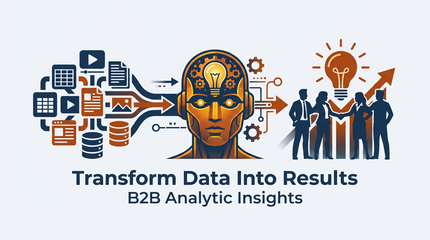
Internal Knowledge + External Insights = Competitive Intelligence. That is your Decision Intelligence Framework.
Capture value where the decision binds. Integrate instead of replace. Govern so you can move. Then shorten the distance between a signal and your response to it.
What is the one decision in your operation that still takes too long? I would genuinely like to hear how other leaders are answering that.
Robert Kirk is Head of Analytics, Global Product at Dun & Bradstreet, supporting AI-driven analytics solutions. With 25+ years in data analytics and decision intelligence, he focuses on financial risk analytics, commercial credit intelligence, and AI-enabled tools that predict cash flow impact across the full business relationship cycle. As founder of B2B Analytics Insights, he shares strategic insights for C-suite leaders across finance, operations, technology, procurement, and people functions. Every role is responsible for the next profitable decision.