
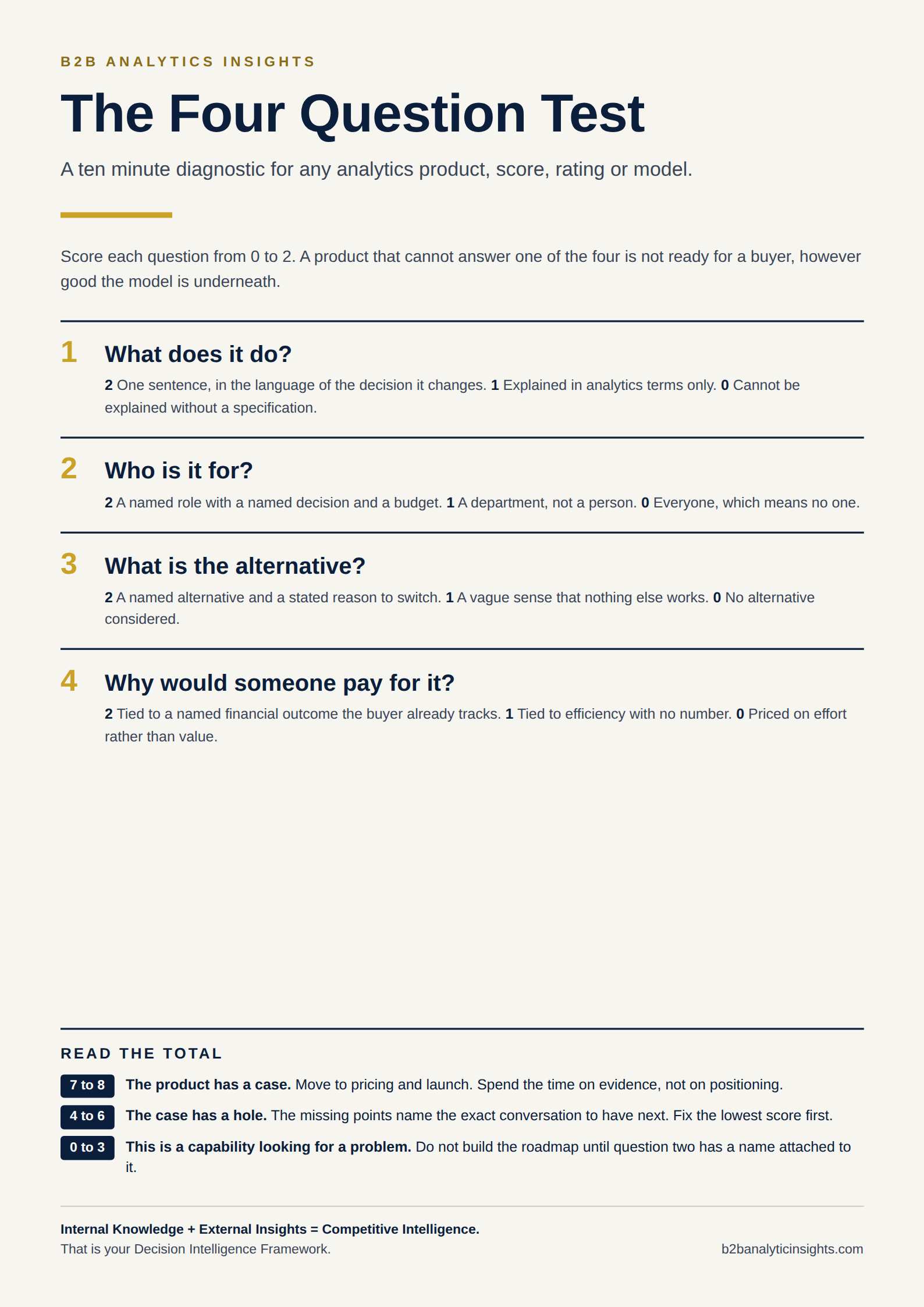
Download the one page version. The Four Question Test, printable PDF.
Most analytics products fail for a reason that has nothing to do with the model. The model works. The buyer cannot place it. They cannot tell what decision it changes, who owns that decision, what they would use instead, or why the result is worth a line in the budget.
The Four Question Test exists to surface that gap in about ten minutes, before a roadmap is approved and long before a launch is scheduled. It is the same four questions I have applied to every analytics asset I have built, and the discipline is that a product has to answer all four in the language of the buyer, not the language of the team that made it.
Question one: what does it do?
Answer in one sentence, in the language of the decision the product changes. A score that predicts delinquency within twelve months does something specific. A score that provides insight into payment behavior does not, because insight is not a decision.
The test is whether the sentence survives translation. If a credit committee member can repeat it accurately after hearing it once, the product passes. If the sentence needs a specification to make sense, it has not been defined yet.
Question two: who is it for?
Name a role, a decision and a budget. This is the question most analytics products fail, and they fail it in the same way: the answer is a department rather than a person, and the budget belongs to no one.
A named buyer changes the product. When the answer is a credit manager deciding a limit, the interface, the evidence and the pricing all follow from that. When the answer is the finance function, every later decision becomes a negotiation.
Question three: what is the alternative?
Every product has an alternative, and it is usually not a competitor. It is a spreadsheet, an internal process, a consultant, or doing nothing and absorbing the loss. The product has to name the alternative and state why switching is worth the disruption.
This question is underrated because it tests for switching reason rather than fit. A product can fit a buyer perfectly and still lose to a spreadsheet, because the spreadsheet is already installed, already trusted and already free.
Question four: why would someone pay for it?
Tie the answer to a financial outcome the buyer already tracks: loss avoided, working capital released, margin protected, cost removed. The buyer is not paying for the analysis. They are paying for the decision it makes cheaper, faster or better.
If the answer is efficiency with no number attached, the product will be priced on effort and bought on discount, which is a slow way to lose a product line.
How to score it
Score each question from zero to two. Two means the answer is specific and defensible. One means the answer exists but stays inside the analytics vocabulary. Zero means the question has not been answered at all.
Seven or eight points means the product has a case, and the next work is evidence and pricing. Four to six means the case has a hole, and the lowest score names the exact conversation to have next. Three or below means this is a capability looking for a problem, and the roadmap should wait until question two has a name attached to it.
Why four questions rather than forty
A longer assessment produces more precision and less action. Four questions can be answered in a meeting, scored in front of the team, and turned into a decision the same day. That matters more than completeness, because the cost of a product that fails is not the analysis it missed. It is the two years spent building the wrong thing.
The test also works in reverse. When a product stalls after launch, the four questions locate the fault quickly. A product nobody can describe is a question one failure. A product nobody owns is a question two failure. A product that sells once and never renews is usually a question three failure, and a product that cannot hold its price is a question four failure.
Put it to work
Run the test on the next three assets on your roadmap before you approve development. Score them honestly, with the person who would own the budget in the room. The pattern in the scores tells you more about the portfolio than any individual answer does.
Internal Knowledge + External Insights = Competitive Intelligence. That is your Decision Intelligence Framework.