The first question in commercial credit has nothing to do with financial performance.
It has nothing to do with cash flow, payment history, or balance sheet strength.
The first question is simpler — and more fundamental:
Is this counterparty real?
The Binary Gateway
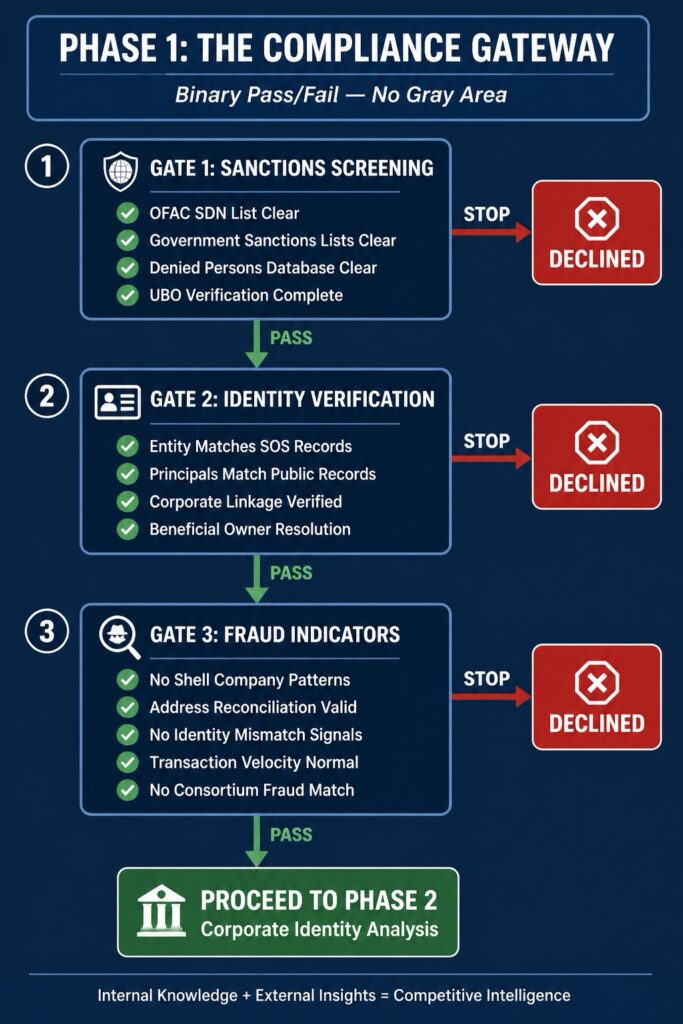
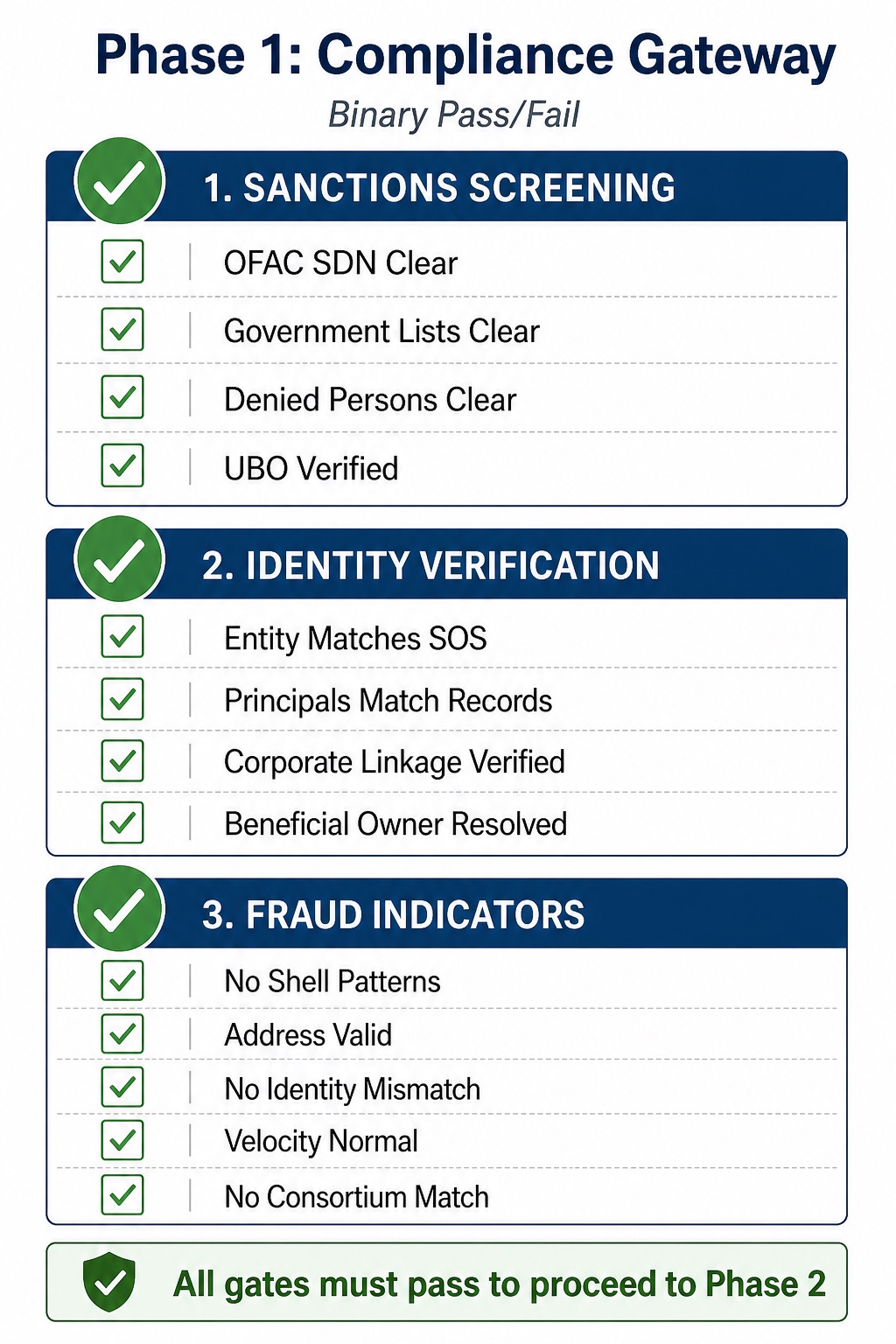
Phase 1 of the credit partnership framework is the compliance gateway. And it’s binary.
Either the entity passes basic identity, sanctions, and fraud screening — or the conversation ends.
There is no middle ground here.
Most credit teams treat this as administrative paperwork. A compliance checkbox on the way to the “real” analysis.
That’s a mistake.
The compliance gateway is where the most catastrophic risks hide. Synthetic identities. Shell companies. Sanctioned entities operating under alternate names. Fraud schemes designed to look legitimate long enough to extract value and disappear.
These risks don’t show up in a balance sheet. They show up here — if you know what signals to watch.
What Good Compliance Screening Actually Looks Like
Identity Verification
Does the legal entity match Secretary of State records? Does the business address exist? Are the principal names consistent across filings?
The fraud pattern: synthetic identities built from real data fragments. The business registration is real. The address is real. The person signing the application exists.
But the combination is fabricated.
Sanctions and Watchlist Screening
Is the entity, its principals, or its beneficial owners on any sanctions list — OFAC, UN, EU, or jurisdiction-specific enforcement databases?
The operational reality: sanctions lists update constantly. A counterparty approved six months ago can become a prohibited entity overnight.
Static screening at onboarding is not sufficient. This needs to run continuously.
Fraud Indicators
Consortium matches. Velocity patterns. Address anomalies. Identity mismatch signals.
D&B intelligence: when an entity shows up in fraud consortia data, or when identity elements don’t reconcile across data sources, that’s not a yellow flag. It’s a stop signal.
The Three Questions That Matter
1. Is this entity who they say they are?
Corporate registration matches stated identity. Principals are verified. Beneficial ownership is transparent.
2. Are they legally prohibited?
No sanctions hits. No enforcement actions that create legal exposure for extending credit.
3. Do the identity elements reconcile?
Names, addresses, tax IDs, registration dates — when the data doesn’t align, that’s not a data quality issue. It’s a signal.
Why This Phase Gets Skipped
Most credit teams are optimized for speed to approval. And compliance screening feels like friction.
But here’s the truth: the fastest way to a bad decision is to skip the step that catches the deal you should never have considered.
A synthetic identity that makes it past Phase 1 will look fine in financial analysis. The fabricated financials will show strength. The trade references will check out — because they’re part of the scheme.
By the time you discover the fraud, the loss is already realized.
The Partnership Principle
The credit partnership framework is built on a simple premise: you don’t extend credit to entities. You extend credit to business partners.
And before you can assess whether someone is a good partner, you need to confirm they’re a real one.
Binary gateway. Pass or stop.
D&B Compliance Intelligence
Key Capabilities:
- Global sanctions screening (OFAC, UN, EU, PEP lists)
- Beneficial ownership resolution
- Identity verification and reconciliation
- Fraud consortium data
- Continuous monitoring (not point-in-time)
The 10-Phase Credit Checking Framework
Phase 1: The Compliance Gateway — You’re here. The binary identity, sanctions, and fraud screening that determines whether a counterparty is real before you ask if they’ll pay.
What’s Next:
- Phase 2: Corporate Identity & Legal Events (Publishing October 30) — Structural health, organizational integrity, and the legal events that signal distress before financials deteriorate
- Phase 3: Operational Assessment (Publishing November 4) — Business viability beyond the balance sheet
- Phase 4: Financial Analysis (November 11) — Traditional ratio analysis in context
- Phase 5: Banking & Capital Structure (November 13) — How they fund operations and what it reveals
- Phase 6: Trade & Payment Behavior (November 18) — The most predictive signals live here
- Phase 7: Alternative Data (November 20) — Digital footprint, supply chain signals, non-traditional intelligence
- Phase 8: The Entrepreneur Lens (November 25) — When the business and the person are inseparable
- Phase 9: Continuous Monitoring (November 27) — Credit risk is not a point-in-time decision
- Phase 10: The Decision (December 2) — Synthesizing intelligence into action
Full Framework Article: November 18, 2026 — all 10 phases integrated with decision intelligence workflow
Internal Knowledge + External Insights = Competitive Intelligence
This is Part 1 of the 10-Phase Credit Checking Framework series.
Next in Series: Phase 2 — Corporate Identity & Legal Events (October 30)
Cite as: b2banalyticinsights.com