

Yesterday the Western WA Fall Credit Forum filled the Museum of Flight in Seattle. Frank Abagnale keynoted. Later in the day I joined a panel on commercial fraud prevention, in a room packed with credit, finance and risk professionals who had given a Thursday to this topic.
The panel’s opening question was simple. If you could eliminate one kind of commercial fraud, which one would you choose?
My answer was misrepresentation. Misrepresentation erodes trust and it creates anomalies that ripple through every other check you run. When identity is false, every downstream signal lies too.
Standing on that stage, I kept returning to one line. Verification must replace trust.
This article is the framework behind that line. It connects the education this profession has always invested in with the verification practices that protect abuse, waste and loss from reaching the income statement. And it ends with the two decisions most organizations still refuse to make: the willingness to exit a relationship, and the discipline to verify the agents now entering the workflow.
Education Is the First Line of Defense
Start with why the room was full.
Frank Abagnale keynoted this forum, and rooms still fill for him for a reason. His story is a standing reminder that fraud is a craft. The people who practice it study. They rehearse. They adapt faster than the controls built to stop them.
The defense has always begun the same way. Education.
NACM has built that habit into the credit profession through certification and continuing education. A credit manager who earns and keeps a designation has been taught to read an application with suspicion and with fairness at the same time. That training matters more than any single tool. It creates instinct.
But here is the problem I have watched for several decades. Education on its own decays.
A control that does not evolve becomes predictable. A lesson learned in a seminar fades under deadline pressure. A checklist followed the same way for years teaches a fraudster exactly where the edges of the process sit.
Education creates the instinct. Verification institutionalizes it. The gap between the two is where most preventable loss lives.
Name the Loss Correctly
The word fraud may be the least useful word in the risk vocabulary.
I said this on the panel and I will keep saying it. Say fraud and people who do not work in fraud stop listening. They hear a cyber problem, or a bank problem, or somebody else’s job. The label quietly excuses the room.
The same loss wears different names. A scam. A scheme. An attack. A misrepresentation. A plan to default. From a credit perspective, the practical concern is loss, including a loss caused by a borrower who never intended to repay and ultimately executes a bust out.
That distinction is not semantic. Each cause needs different evidence and a different response, even when the financial consequence looks identical on the ledger. External shocks explain some losses, like an energy cost that breaks a sector. Behavior outside the norm explains others. A customer who deteriorates financially is not the same event as an identity that was never real. Collapsing them into one label funds the wrong playbook.
And the taxonomy carries a management cost. A loss you cannot explain to your CFO, a director, or a credit manager is the hardest loss to manage. Name the cause correctly and the right control appears. Name everything fraud and the board stops asking good questions.
Every Role Owns the Next Profitable Decision
Abuse, waste and loss are not the fraud team’s problem. They are a CXO problem, and the lens is always financial.
A CFO sees margin erosion and unexplained write offs. A Chief Risk Officer sees exposure that was never quantified. A Chief Procurement Officer sees a vendor file built on documents nobody verified. A CEO sees a growth plan that assumes receivables will convert to cash on schedule. When misrepresentation sits undetected inside the file, every one of those leaders is making decisions on fiction.
That is the master principle. Every role is responsible for the next profitable decision. Fraud prevention is not a defensive cost center. Done well, it is how the next profitable decision gets made on true information.
Why Now: The Confidence Risk
Commercial fraud is accelerating for a reason that has nothing to do with criminal genius. The channel opened.
Commercial channel fraud received comparatively little attention for years while consumer identity fraud took the headlines. As businesses moved online and automated their processes, the commercial channel became the softer target. Credit limits run larger in commercial relationships. Protections are less developed. A fraudster who can pass a business identity check reaches far more money in one attempt than a consumer scheme typically pays.
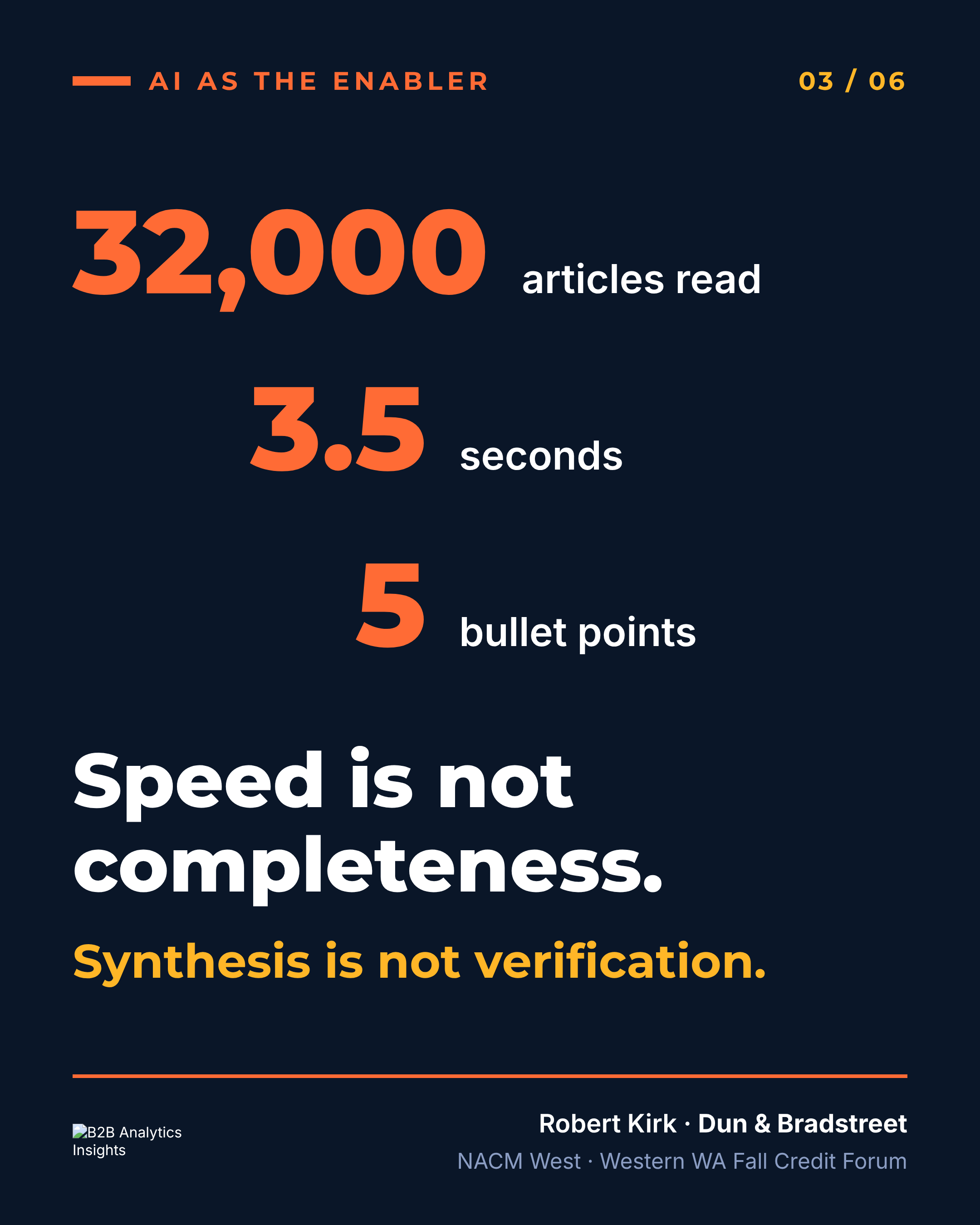
Now add the technology shift. On the panel I offered a concrete picture. An AI agent can read 32,000 articles in less than 3.5 seconds and reduce them to five bullet points.
The question I raised from the stage was this. Does that compression preserve every critical point?
Speed is not completeness. Synthesis is not verification.
The risk I flagged is not the technology. It is the confidence. Business processes are getting faster while organizations assume they already have sufficient information, or that anything missing can be pulled from AI on demand. That confidence is a major marketplace risk. Organizations outsource judgment to technology even as the technology moves faster than their ability to respond. A fabricated trade reference, a generated utility bill, a synthetic identity attached to a dormant company record: the tools of misrepresentation are now free, fast and everywhere.
The Framework: Five Moves of Verification
Here is the operating answer, drawn from the panel conversation and from the Decision Intelligence work behind it. Five moves.
Move 1. Verify identity before anything else.
Misrepresentation was my answer to the panel’s opening question because identity is the foundation layer. When identity is false, every downstream signal lies too. Get identity right and the harder schemes lose their cover. A fabricated document meets a real record. A recycled phone number meets its carrier. A company with six weeks of history meets its own story. Compare what was submitted against known good third party sources, and recheck the signals fraudsters recycle.
Move 2. Place the friction at the right time.
Create the right friction at the right time. Challenge the suspicious case. Test it. Compare it. Then let every ordinary business pass without treating it as an extraordinary exception. Friction done well is not a department of no.
Move 3. Triangulate. Benchmark. Never redline.
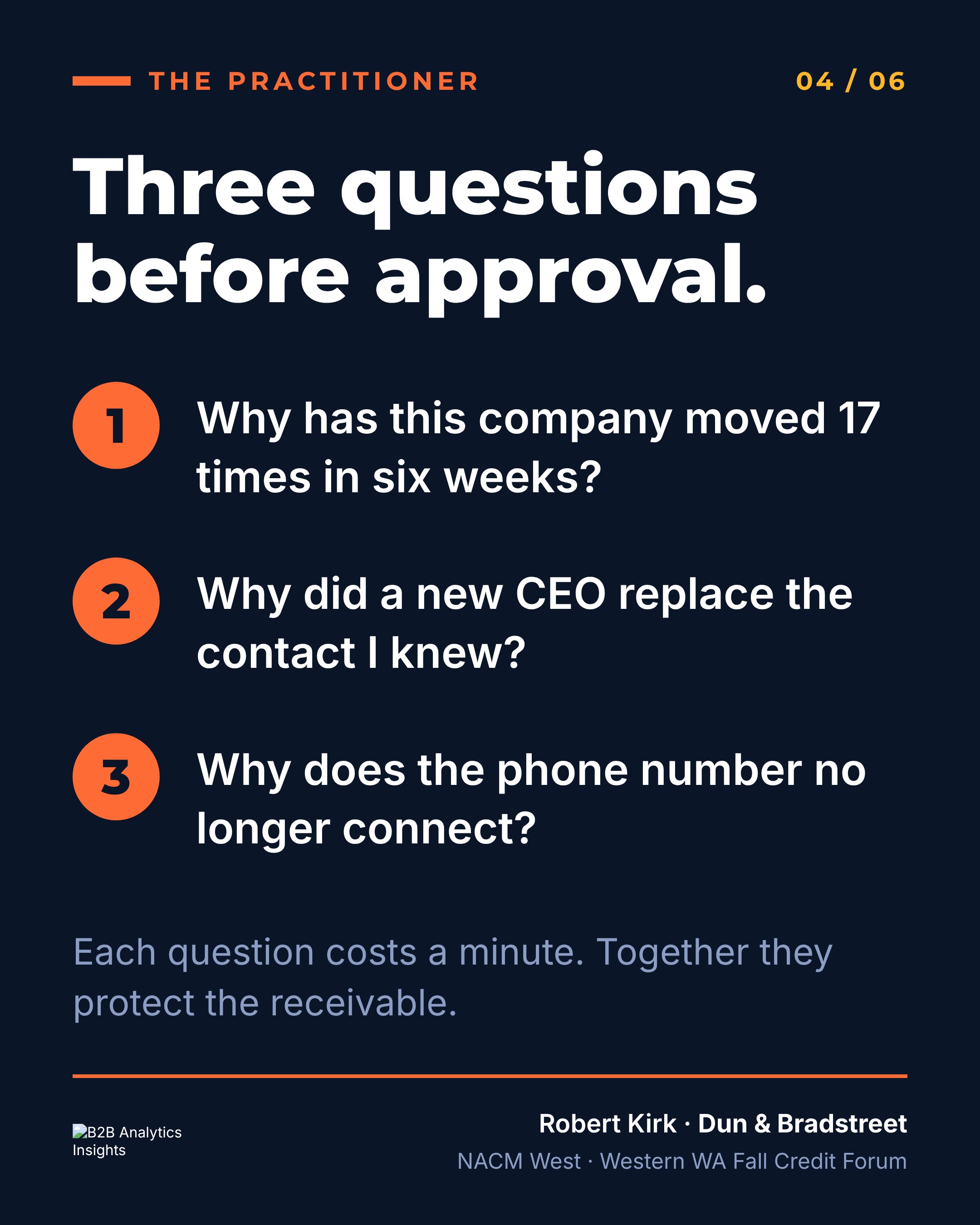
One signal proves nothing. An IP address inconsistent with the claimed origin. An ownership change dated weeks before the application. A phone number that maps to an app instead of a carrier. Each has an innocent explanation. Combined, they earn investigation before approval. Fraudsters combine identity elements to build a convincing picture, so verification has to combine signals too. Compare the file against peers in the same industry and geography, and hold a clear line: benchmarking is comparison that prompts further questions. It is not redlining, and the distinction protects both the customer and the institution.
Move 4. Monitor the video, not the photograph.
A credit report is a photograph. Fraud moves like a video. The direction verification is heading is beyond the current snapshot, toward a view of how a company looked last week, last quarter and further back. Direction and speed of change carry the signal. People change, businesses change, but they change slowly and often predictably. When the change speeds up, the friction belongs there. One panelist’s example made it concrete: a dormant business record, re-added just months before an application, deserves a question. Set expectations for the anomaly. Investigate it. Apply the appropriate friction at the appropriate time.
Move 5. Be willing to act, and verify the agents.
This is the move most organizations still refuse, and it is where the panel’s advice becomes a decision.
Be willing to close the account when the signals say the relationship is no longer sound. I said it on the panel as the thing nobody wants to do but you need to do: close down the dormant accounts, close the accounts with no activity and make them reapply. Every dollar of credit left standing in an account you already distrust is working capital denied to a customer who deserves it. A limit you know is too high is not generosity. It is unpriced exposure on your own balance sheet.
And as we move into the new era, extend the same discipline to the agents. Agent to agent is the next exposure, and it becomes the next triangulation. AI agents now read, summarize and recommend inside credit workflows. Verify their output against trusted sources before it touches a credit decision, a payment instruction or a vendor file. Ask the same question twice and compare. Treat the agent as a fast, tireless analyst who still requires review, because the enabler never signs the decision. Analytics first, AI as the enabler. That order is the whole discipline.
The Payoff
What does this framework buy? Cash flow you can trust.
Receivables built on verified identity convert on schedule. Working capital stops leaking into accounts that were never sound. Margin stops absorbing losses that a one minute question would have caught. And the discipline scales: the same five moves protect a small trade line and a multimillion dollar exposure alike.
There is a public dimension too, and a panelist made it well. Fraud cannot be eliminated entirely, but minimizing it preserves money for legitimate purposes. Inside a company, that preserved money is margin and working capital. In public programs, it is funding for food, housing and education. Verification is not overhead. It is how money gets where it was intended to go.
Education gave this profession its instinct. Certification keeps it current. Verification institutionalizes it, one decision at a time.
Internal Knowledge + External Insights = Competitive Intelligence. That is your Decision Intelligence Framework.
Related read: The Right Check at the Right Time, the lifecycle framework behind the five moves.
Robert Kirk is Head of Analytics, Global Product at Dun & Bradstreet, and founder of B2B Analytics Insights. Every role is responsible for the next profitable decision. That is the lens.